Audience Simulation for Ads

Predict how your buyers react — before you spend.

Upload two static ads, choose your buyer, and get a quick prediction with clear next steps.

70% accurate on real ad CTR
Calibrated against real ads
30-second results
No ad account needed
Kettio audience simulation: a synthetic-audience brain projects buyer personas onto an ad, which is then swiped right or left for approval.

Score for the channels you run

Amazon Sponsored Brands
Meta Advantage+ Shopping
YouTube Video Ads
Instagram Reels Ads
Facebook Dynamic Ads
TikTok Spark Ads
Reddit Promoted Posts
Pinterest Shopping Pins
Shopify Product Listings
Amazon Sponsored Brands
Meta Advantage+ Shopping
YouTube Video Ads
Instagram Reels Ads
Facebook Dynamic Ads
TikTok Spark Ads
Reddit Promoted Posts
Pinterest Shopping Pins
Shopify Product Listings

How it works

Render the audience. Read the reaction. Score the ad.

Three steps. Thirty seconds. No ad account, no spend.

Kettio audience picker showing pre-built buyer cohorts ready to simulate against.

Step 01

Pick an audience

Pre-built buyer cohorts or audiences built from your real customer profile.

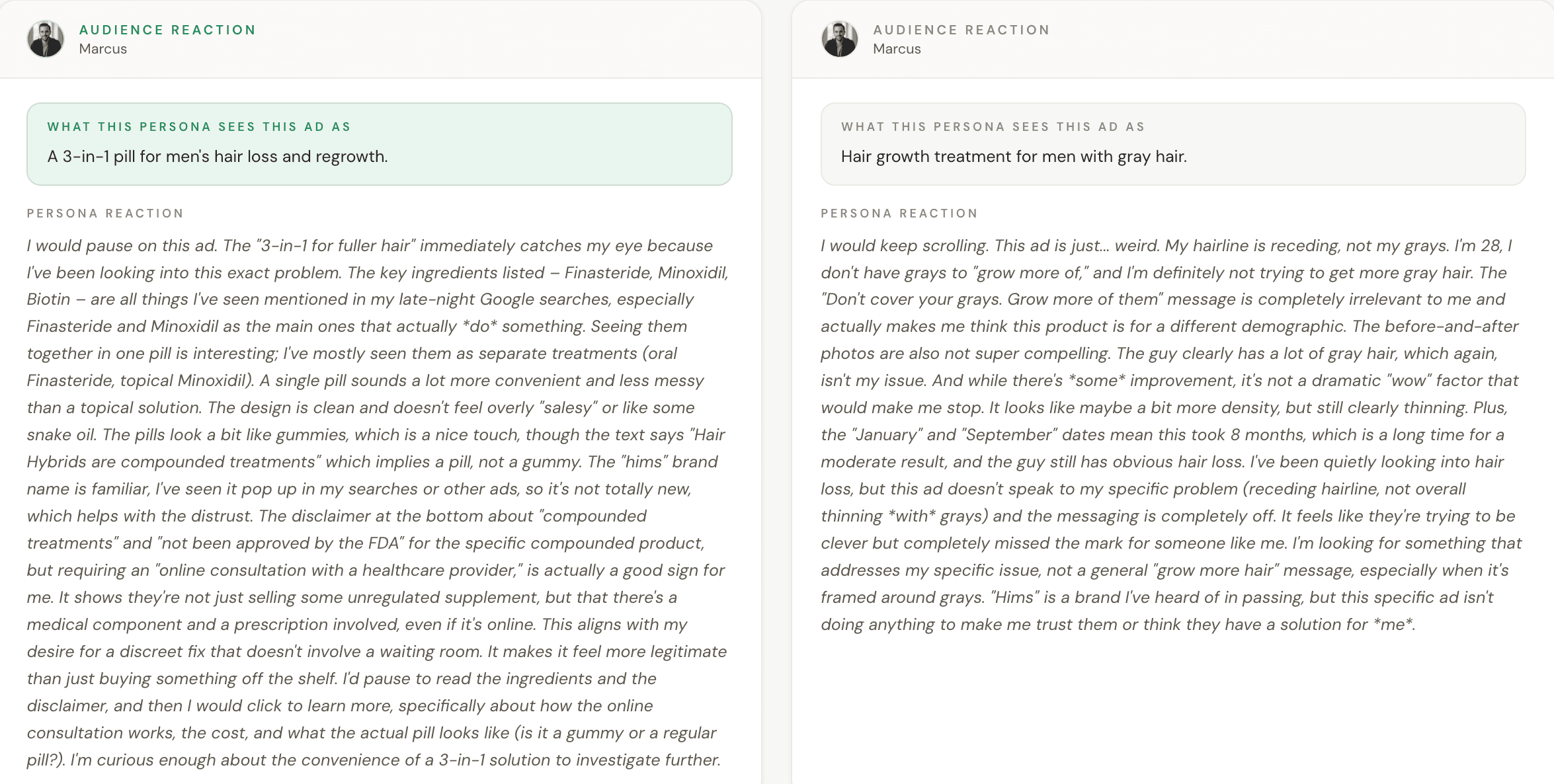
Kettio simulation results showing per-persona reactions to an ad creative.

Step 02

Watch them react

Synthetic respondents view your ad and react in plain English — one persona at a time.

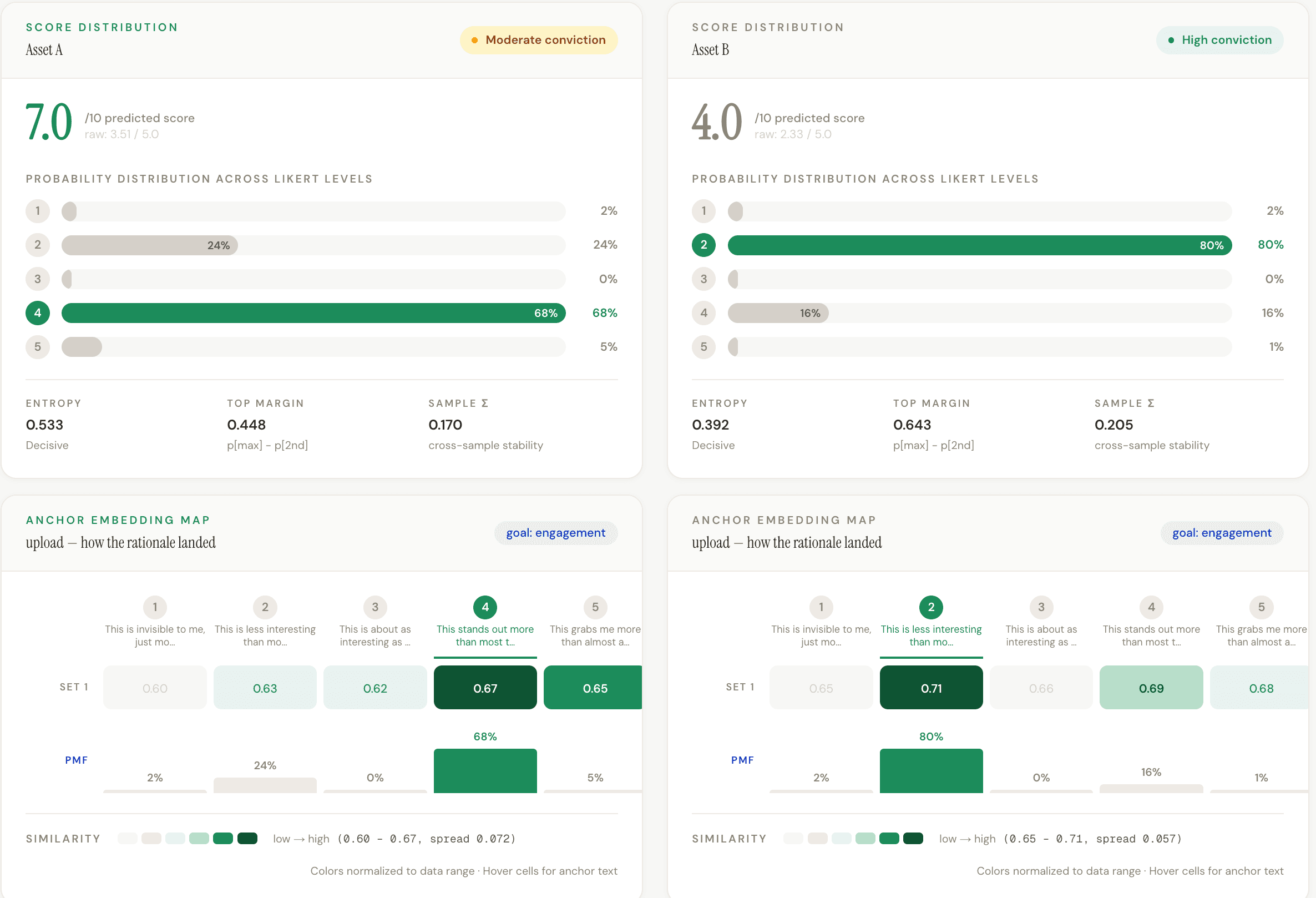
Kettio ranked-asset score view with a calibrated 1-10 audience-simulation score.

Step 03

Get the score

A calibrated 1–10 score with the reasoning behind it. Ship the winners, kill the losers.

How it works

How Kettio predicts which ad is stronger.

You provide the competing ads, the buyer, and the goal. Kettio simulates likely buyer responses, compares every ad on the same scale, and returns a directional winner before you spend.

01 Upload your ads

Add the ads you are choosing between.

Kettio compares like with like: static images, copy, or full ad packages. Each creative is evaluated separately so one ad cannot influence the read on another.

02 Choose the buyer and goal

Tell Kettio who you want to persuade.

Choose the platform, conversion goal, and buyer profile. Those choices determine the context and the question the simulated audience evaluates.

03 Simulate the response

Kettio models how that buyer is likely to react.

AI respondents modeled on your chosen buyer evaluate each ad independently. Their responses are compared with calibrated anchors and combined into a directional ranking.

04 Make the decision

Get a winner, the reasons, and clear next steps.

See which ad leads, why it leads, how confident the read is, and what to improve. Kettio flags close calls; live media remains the final proof.


Illustration of Kettio modeling audience reactions

How it works

From creative batch to launch shortlist.

Bring the work your team already produced. Attach the buyer, platform, and goal; Kettio ranks what deserves spend and explains the decision.

Step 01

Connect your stack

Bring in creative without losing the campaign context around it.

Meta
Google
TikTok
Instagram
Pinterest
Shopify
Canva
Figma
Notion

Step 02

Define the audience

Choose the persona, segment, or vertical you actually buy against.

Men's Performance Seekers

Ages 35-44

Men's Performance Seekers

Nurse Weight Loss

Ages 25-34

Nurse Weight Loss

Senior Weight Management

Ages 65+

Senior Weight Management

Affordable Rx Seekers

Ages 35-44

Affordable Rx Seekers

GLP-1 Weight Loss Seekers

Ages 25-34

GLP-1 Weight Loss Seekers

MidWestern Men Americans

Ages 45-54

MidWestern Men Americans

Priya

Ages 25-34

Priya

Marcus

Ages 25-34

Marcus

Millennial DTC Skincare

Ages 25-34

Millennial DTC Skincare

Tripod Purchasers

Ages 18-24

Tripod Purchasers

Office & WFH Workers

Mixed

Office & WFH Workers

Olivia

Mixed

Olivia

Expensive Home Owners

Mixed

Expensive Home Owners

Men's Performance Seekers

Ages 35-44

Men's Performance Seekers

Nurse Weight Loss

Ages 25-34

Nurse Weight Loss

Senior Weight Management

Ages 65+

Senior Weight Management

Affordable Rx Seekers

Ages 35-44

Affordable Rx Seekers

GLP-1 Weight Loss Seekers

Ages 25-34

GLP-1 Weight Loss Seekers

MidWestern Men Americans

Ages 45-54

MidWestern Men Americans

Priya

Ages 25-34

Priya

Marcus

Ages 25-34

Marcus

Millennial DTC Skincare

Ages 25-34

Millennial DTC Skincare

Tripod Purchasers

Ages 18-24

Tripod Purchasers

Office & WFH Workers

Mixed

Office & WFH Workers

Olivia

Mixed

Olivia

Expensive Home Owners

Mixed

Expensive Home Owners

Expensive Home Owners

Mixed

Expensive Home Owners

Olivia

Mixed

Olivia

Office & WFH Workers

Mixed

Office & WFH Workers

Tripod Purchasers

Ages 18-24

Tripod Purchasers

Millennial DTC Skincare

Ages 25-34

Millennial DTC Skincare

Marcus

Ages 25-34

Marcus

Priya

Ages 25-34

Priya

MidWestern Men Americans

Ages 45-54

MidWestern Men Americans

GLP-1 Weight Loss Seekers

Ages 25-34

GLP-1 Weight Loss Seekers

Affordable Rx Seekers

Ages 35-44

Affordable Rx Seekers

Senior Weight Management

Ages 65+

Senior Weight Management

Nurse Weight Loss

Ages 25-34

Nurse Weight Loss

Men's Performance Seekers

Ages 35-44

Men's Performance Seekers

Expensive Home Owners

Mixed

Expensive Home Owners

Olivia

Mixed

Olivia

Office & WFH Workers

Mixed

Office & WFH Workers

Tripod Purchasers

Ages 18-24

Tripod Purchasers

Millennial DTC Skincare

Ages 25-34

Millennial DTC Skincare

Marcus

Ages 25-34

Marcus

Priya

Ages 25-34

Priya

MidWestern Men Americans

Ages 45-54

MidWestern Men Americans

GLP-1 Weight Loss Seekers

Ages 25-34

GLP-1 Weight Loss Seekers

Affordable Rx Seekers

Ages 35-44

Affordable Rx Seekers

Senior Weight Management

Ages 65+

Senior Weight Management

Nurse Weight Loss

Ages 25-34

Nurse Weight Loss

Men's Performance Seekers

Ages 35-44

Men's Performance Seekers

Step 03

Set platform and conversion goal

Rank for purchase intent, conversion potential, CTR, or trust.

Platform: Meta
Objective: Traffic

Step 04

Rank the batch

See which creatives deserve launch, which should wait, and why.

WinnerVariant A
Interested
Variant B
On the fence

Step 05

Refine the winner

Turn the winning direction into a stronger launch variant, then send the decision back into your workflow.

Winning directionTurn the signal into the next ad.
Building variant
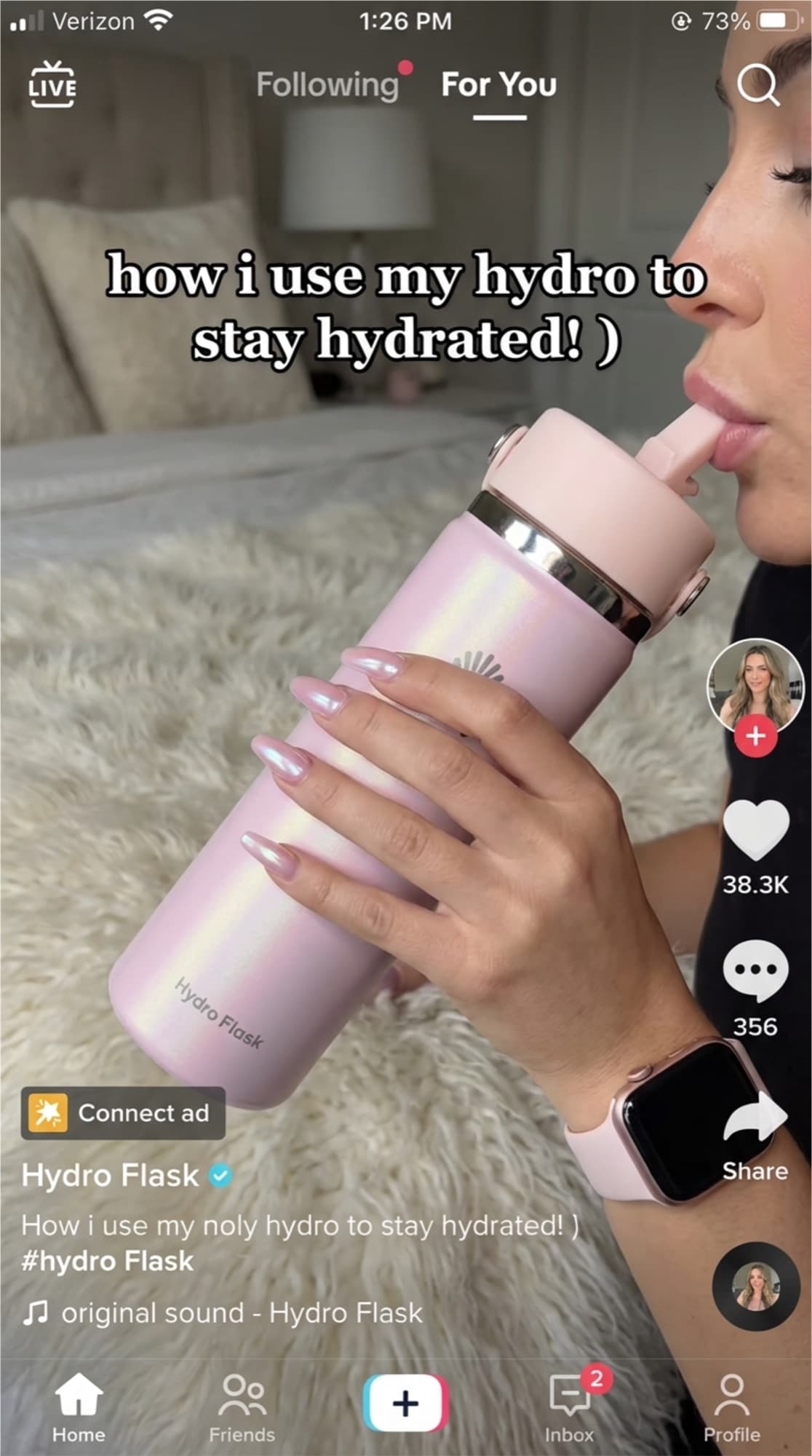
Winning Hydro Flask bedroom creative
Selected winner8.4
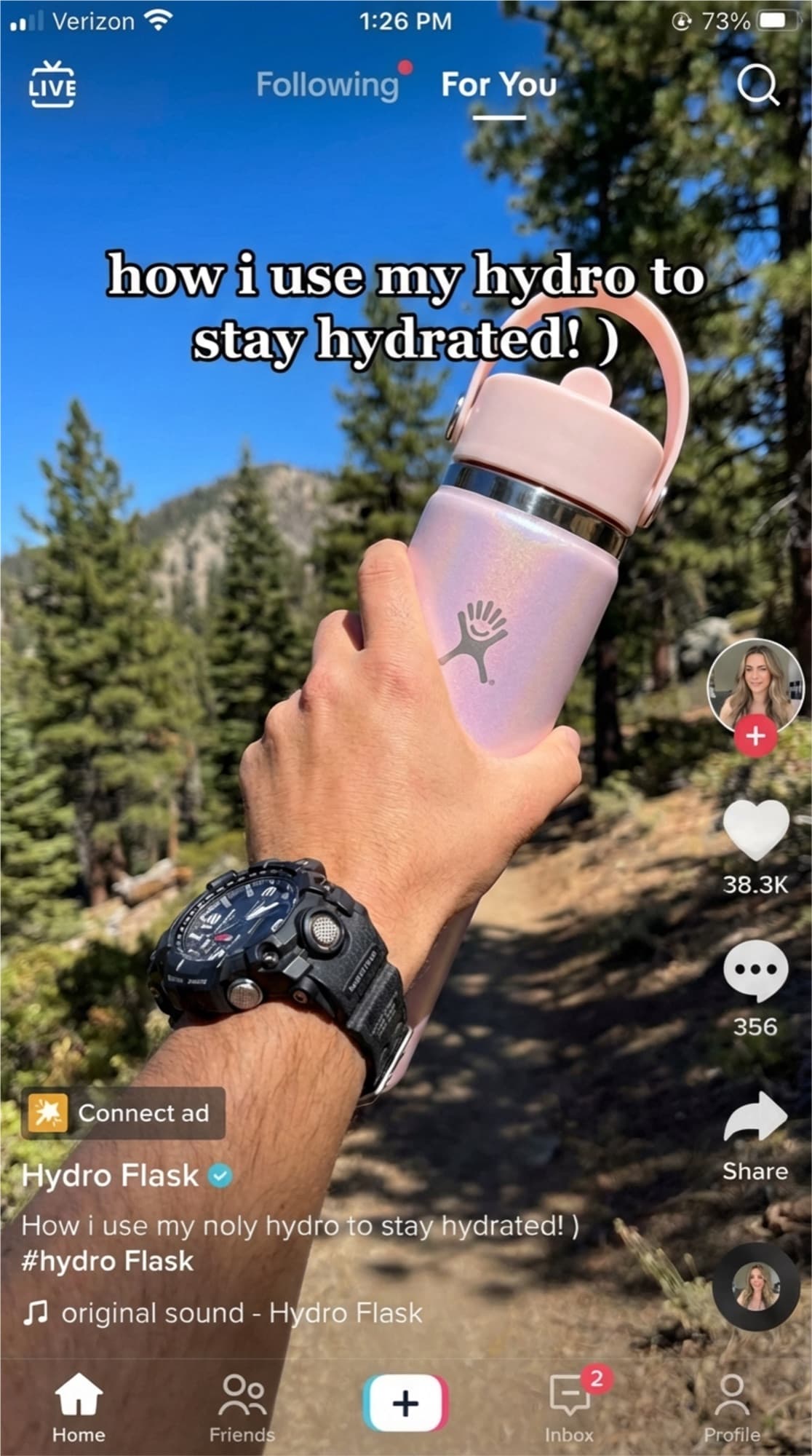
Refined Hydro Flask outdoor-use creative
Context variant9.1
Re-ranking against the same buyerPreserving the winning hook.
8.4
9.1

Benchmarks

Built to win before launch.

77.5%

matched real buyer behavior

Kettio reads image, copy, and the full ad separately — so your budget backs the creative your buyer actually leans toward, not the one you guessed.

Imagevisual pull
Copyhook + claim
Image + copyfinal winner

Accuracy over time

How often Kettio matched what real buyers did

0%30%60%90%Apr 1Apr 15May 1May 1351.1%+7.3 pts58.4%+19.1 pts77.5%Kettio winner calls

What you can do with it

Three jobs simulation does that live A/B testing can’t.

Pre-launch validation

Score creatives before you spend a dollar on media.

Every Meta A/B test costs $200–500 in spend and two weeks of waiting before you have statistical significance. Audience simulation gives you a directional read in 30 seconds, so you can kill the obvious losers before any budget moves and run your live test on creatives that actually have a shot.

Audience-fit testing

Compare how different buyer cohorts react to the same ad.

A creative that lands with Skeptical Millennial Browser doesn’t always land with Cautious Parent Researcher. Simulate the same ad against different audiences and see where it actually fits — and where it’s about to leak budget on a cohort that doesn’t care.

Concept exploration

Test angles and offers before you brief a creative team.

You don’t need a finished ad to run simulation. Test mood boards, competitor inspiration, mock-ups, or text-only concepts. The score is directional — the rationale tells you which angle a buyer audience actually responds to before you spend on production.

Frequently asked

Common questions about audience simulation.

Audience simulation is a method for predicting how a buyer audience will react to an ad creative without running it as a live campaign. Kettio generates synthetic respondent reactions from a chosen audience profile, embeds each reaction against calibrated anchor reference texts, and returns a 1–10 score with a conviction label. The result is a directional read on creative performance you can use to decide which creatives are worth your media budget.

Kettio’s SSR (Silicon Survey Ranking) engine has been validated against the University of Washington ad-perception survey at ρ=0.775 (n=160 paired creatives, text-embedding-3-large) and against the CreativeRanking real-CTR panel at 70.3% within-product pairwise. We publish the benchmarks because we measure them — competitors that claim prediction rarely do.

No. Kettio scores creatives without any ad account, pixel, or historical campaign data. Upload an image or paste a URL and the simulation runs against a chosen audience. This is what makes pre-launch scoring possible — there’s nothing to integrate before you can use it.

Kettio ships with four pre-built personas (Skeptical Millennial Browser, Loyal Boomer Ready to Buy, Gen Z Impulse Scroller, Cautious Parent Researcher) and lets you build custom audiences from your real buyer profile — demographics, motivations, objections, ad skepticism. The custom-audience layer is what turns a generic AI scorer into a brand-specific one.

AdCreative.ai outputs a confidence percentage from a single proprietary model with no published validation against real ad performance. Kettio publishes ρ against UW (0.775) and within-product pairwise on CreativeRanking (70.3%) so you can audit the prediction quality. Every score also ships with a rationale — the persona reactions in plain English — so you can see why a score landed where it did.

Yes. You can upload a mock-up, a competitor’s ad you’re drawing inspiration from, or even early concept boards. Simulation only needs an image and an audience — it doesn’t care whether the creative is final, draft, or borrowed.

Most runs return a calibrated score in 15–30 seconds. Two language models (Flash + Haiku) generate persona reactions in parallel, then we embed and score against anchor reference texts using text-embedding-3-large.

JPG, PNG, and WebP creatives for Meta feed, Meta stories/reels, TikTok in-feed, Google Display, LinkedIn single image, Amazon Sponsored Brands, Reddit Promoted Posts, and Pinterest Standard Pins. Each platform unlocks objective-specific scoring (Sales, Engagement, Awareness, Traffic, and more) because what reads as a winning ad on Meta doesn’t always read the same way on Google Display.

No — it’s a filter for it. A live A/B test on Meta costs $200–500 of spend and roughly two weeks before you have statistical significance. Audience simulation gives you a 30-second directional read so you can kill the obvious losers and run your live test on creatives that actually have a chance. The two methods are complementary: simulation eliminates wasted spend; live testing confirms the survivors.

Run your first simulation

Audience simulation in 30 seconds. No ad account. No credit card.

Upload two static ads, choose your buyer, and get a quick prediction with clear next steps. No signup or credit card.