
On this page11 sections
- What Is an AI Marketing Agent?
- Why AI Agent Marketing Matters Now
- The Application Layer Problem
- What Agents Can Do with Kettio
- Architecture: How an AI Marketing Agent Works
- Quick Example: A Complete Agent Workflow
- Evaluation Goals: Matching Agent Actions to Business Objectives
- Audience Modeling: The Highest-Leverage Variable
- Confidence and Statistical Rigor
- Building Your First AI Marketing Agent
- Frequently Asked Questions
AI agent marketing is the practice of using autonomous AI agents to execute marketing decisions — scoring creatives, researching audiences, testing ad variants, and optimizing campaigns — without manual intervention at every step. Instead of asking a chatbot for suggestions, you give an agent access to marketing tools and let it act.
This guide covers what AI agent marketing is, why it matters, and how to build agent-powered marketing workflows using Kettio as the application layer. Every example uses real API endpoints you can call today.
What Is an AI Marketing Agent?
An AI marketing agent is software that combines a large language model (LLM) with tool access to autonomously perform marketing tasks. The key difference between an agent and a chatbot is agency — the ability to take actions, not just generate text.
A chatbot says: "I think Ad A will perform better because it has stronger contrast."
An agent says: "I scored Ad A and Ad B against your target audience. Ad A scored 4.23 (high confidence) on purchase intent. Ad B scored 2.87. Here's why, and I've already generated three variants of Ad A to test next."
The difference is that the agent actually did the work. It called scoring APIs, interpreted results, and took the next logical action.
Why AI Agent Marketing Matters Now
Three things converged to make AI agent marketing practical in 2025-2026:
- Tool-use in LLMs. Models like Claude, GPT-4, and Gemini can now call external APIs reliably. This means you can give an agent access to a scoring API, and it will format requests, parse responses, and act on results without custom integration code for every step.
- Model Context Protocol (MCP). Anthropic's MCP standard gives agents a universal way to discover and use tools. Instead of hardcoding API calls, an MCP-enabled agent can connect to any MCP server and immediately use its capabilities. Kettio ships an MCP server that gives Claude instant access to creative scoring, generation, and editing.
- Application-layer APIs. Raw LLMs can't reliably score creative performance. They hallucinate metrics, regress to the mean, and produce scores that don't correlate with real outcomes. Application layers like Kettio sit between the agent and the marketing decision — providing calibrated scores, structured audience models, and statistically rigorous A/B comparisons that agents can trust.
The Application Layer Problem
Here's the fundamental issue with asking an LLM to evaluate your ads directly:
You: "Rate this ad on a scale of 1-5 for purchase intent."
LLM: "I'd rate this a 3.5 out of 5. The ad has good visual contrast
      but could improve its call-to-action."
This score is meaningless. The model has no calibrated sense of what a "3.5" means relative to thousands of other ads. It will give almost everything a 3-4. The scores don't correlate with actual human preferences.
Kettio solves this with the SSR (Semantic Similarity Rating) pipeline. Instead of asking a model to output a number, SSR:
- Builds a synthetic audience persona from your target demographics — age, income, ad skepticism, platform fatigue, shopping intent, and more.
- Generates multiple independent evaluations using an ensemble of models (Gemini Flash + Claude Haiku), each writing a natural-language rationale from the persona's perspective.
- Embeds the rationales against calibrated anchor texts using OpenAI's text-embedding-3-small.
- Computes similarity scores that are statistically meaningful — they correlate with actual human preferences at ρ = 0.58+ on academic benchmarks.
This is what we mean by "application layer." The agent doesn't need to understand psychometrics or embedding spaces. It calls POST /api/v1/rank and gets back ranked results with confidence intervals it can trust.
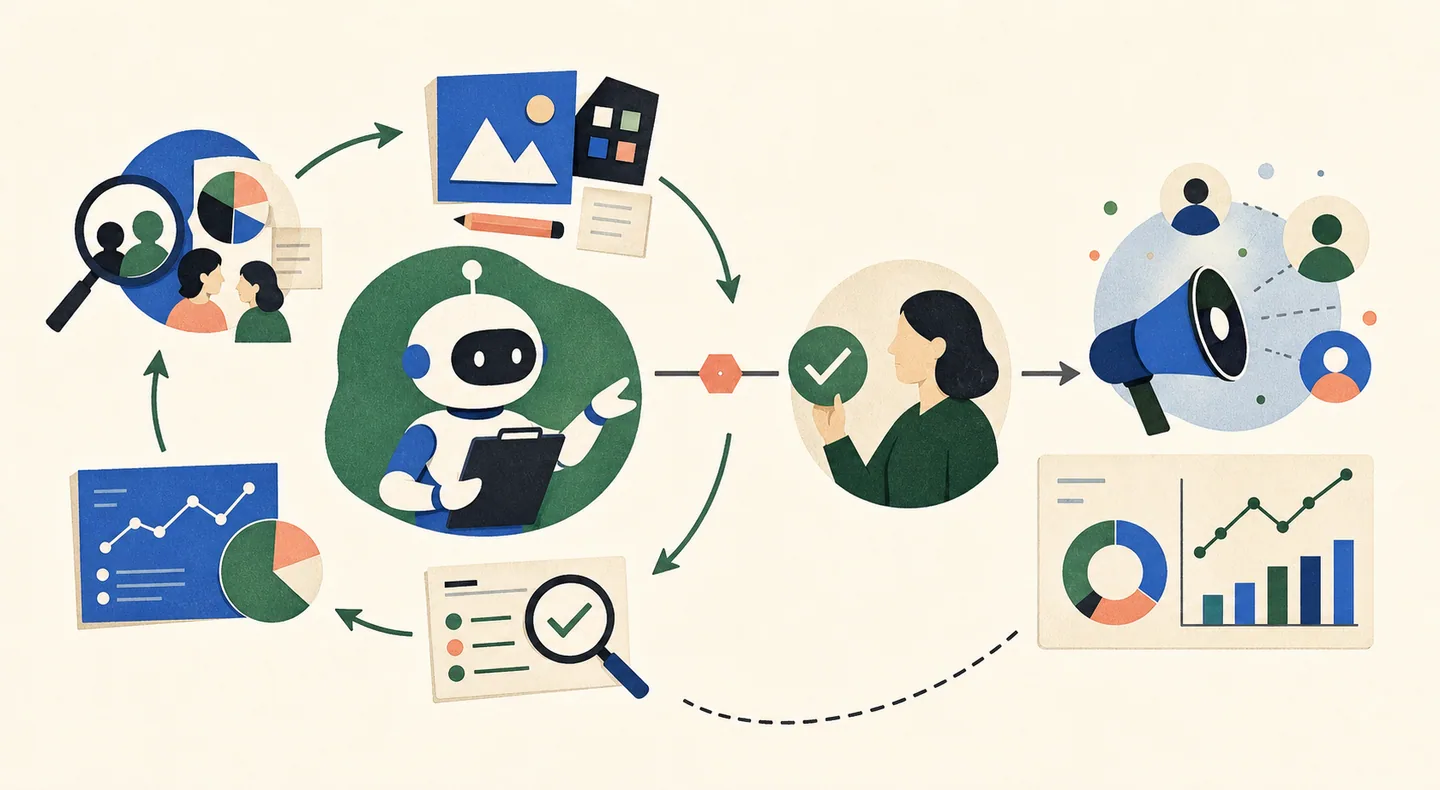
What Agents Can Do with Kettio
Here's the full set of marketing actions an AI agent can take through Kettio's API:
| Action | Endpoint | What It Does |
|---|---|---|
| Score & Rank Creatives | POST /api/v1/rank |
Submit 1-20 images, get them ranked by predicted performance against a target audience |
| Research Audiences | POST /api/audiences/research |
Give a brand URL, get back 3 inferred audience segments with full demographics |
| Create Audiences | POST /api/audiences |
Save a target audience persona with structured demographics for reuse |
| A/B Test Creatives | POST /api/champion-challenger |
Run a blinded Bradley-Terry pairwise comparison with statistical confidence |
| Generate Creatives | POST /api/mcp/generate |
Generate new ad images from a prompt with brand context |
| Edit Creatives | POST /api/mcp/edit |
AI-edit existing images with natural language instructions |
| Get Edit Recommendations | POST /api/rank-assets/recommend-edits |
Get 3 specific "just-detectable-difference" edit suggestions to improve a scored ad |
Architecture: How an AI Marketing Agent Works
A typical AI marketing agent follows this loop:
flowchart TD
    A[Brand URL or Brief] --> B[Research Audiences]
    B --> C[Create Target Personas]
    C --> D[Score Existing Creatives]
    D --> E{Score Good Enough?}
    E -->|Yes| F[Launch Campaign]
    E -->|No| G[Get Edit Recommendations]
    G --> H[Generate Variants]
    H --> D
Each node in this diagram maps to an API call. The agent orchestrates the flow, makes decisions at branching points, and iterates until the creatives meet a quality threshold.
Quick Example: A Complete Agent Workflow
Here's what a full agent workflow looks like in code. This agent takes a brand URL, discovers the target audience, scores some ad creatives, and generates improvement recommendations.
// Step 1: Research the brand's audience
const audienceRes = await fetch('https://kettio.com/api/audiences/research', {
  method: 'POST',
  headers: {
    'Authorization': 'Bearer agk_live_YOUR_KEY',
    'Content-Type': 'application/json'
  },
  body: JSON.stringify({ url: 'https://example-brand.com' })
});
const { segments } = await audienceRes.json();

// Step 2: Score creatives against the top audience segment
const rankRes = await fetch('https://kettio.com/api/v1/rank', {
  method: 'POST',
  headers: {
    'Authorization': 'Bearer agk_live_YOUR_KEY',
    'Content-Type': 'application/json'
  },
  body: JSON.stringify({
    assets: [
      { url: 'https://cdn.example.com/ad-spring-sale.png', id: 'spring-sale' },
      { url: 'https://cdn.example.com/ad-lifestyle.png', id: 'lifestyle' },
      { url: 'https://cdn.example.com/ad-product-hero.png', id: 'product-hero' }
    ],
    audience: {
      name: segments[0].name,
      description: segments[0].name,
      demographics: segments[0].demographics
    },
    goal: 'purchase-intent'
  })
});
const { ranked, summary } = await rankRes.json();

console.log(`Top creative: ${ranked[0].asset_id} (score: ${ranked[0].score})`);
console.log(`Rationale: ${ranked[0].rationale}`);
console.log(`Credits used: ${summary.credits_used}`);
In under 20 lines of code, the agent discovered who the brand's customers are and determined which creative will resonate most with them. No human scored anything. No survey was fielded. No media budget was spent.
Evaluation Goals: Matching Agent Actions to Business Objectives
One of the most important decisions an AI marketing agent makes is what to optimize for. Kettio supports 14 evaluation goals, each tuned for a different stage of the marketing funnel:
| Goal | Funnel Stage | When to Use |
|---|---|---|
scroll-stopping |
Top | Feed ads, Reels, Stories — will people stop scrolling? |
click-through-rate |
Top | Display ads, social — will people click? |
engagement |
Top–Mid | Social posts — likes, comments, shares |
brand-recognition |
Mid | Brand awareness campaigns |
emotional-resonance |
Mid | Brand storytelling, video |
trustworthiness |
Mid | Finance, health, insurance — does it feel credible? |
purchase-intent |
Bottom | Product ads, e-commerce — will people buy? |
conversion-potential |
Bottom | Lead gen, signups, downloads |
landing-page-conversion |
Bottom | Landing page hero images |
product-page-conversion |
Bottom | Product listing images on e-commerce sites |
open-rate |
Top | Email header images |
logo-professionalism |
Brand | Logo design evaluation |
logo-versatility |
Brand | Logo adaptability across contexts |
A smart agent selects the goal based on the campaign context. Running Instagram feed ads? Use scroll-stopping. Optimizing product detail pages on Shopify? Use product-page-conversion. The goal changes how the synthetic audience evaluates your creative — what they pay attention to, what they criticize, and what drives the final score.
Audience Modeling: The Highest-Leverage Variable
Our research found that audience persona is the single highest-leverage variable in creative scoring. A generic persona achieves ~55% pairwise accuracy. A targeted persona with real demographics pushes that to 63-67% — a massive improvement in predictive power.
This validates the entire premise of AI agent marketing: the agent needs to know who it's optimizing for. Kettio's audience model includes:
- Age range — different generations respond to different visual cues
- Income level — affects price sensitivity and perceived value
- Ad skepticism — how resistant is this audience to advertising?
- Trust baseline — do they default to trusting or doubting brands?
- Shopping intent — browsing, researching, comparing, or ready to buy?
- Platform fatigue — how burned out are they on ads in their feed?
- Category familiarity — novice or expert in the product category?
- Brand familiarity — never heard of you, or already loyal?
When an agent calls POST /api/audiences/research with a brand URL, Kettio scrapes the site, analyzes the brand positioning, and returns up to 3 inferred audience segments with all these fields populated. The agent can then use these segments directly in scoring calls.
For a deeper walkthrough, see our guide on AI-powered audience research.
Confidence and Statistical Rigor
One thing that separates Kettio from raw LLM scoring is confidence estimation. Every scored asset returns a confidence level (high, medium, or low) with detailed metrics:
{
  "confidence": "high",
  "confidence_details": {
    "entropy": 0.42,
    "top_margin": 0.31,
    "sample_std_dev": 0.08
  }
}
- Entropy — how spread out the probability distribution is across score buckets. Lower = more decisive.
- Top margin — the gap between the top score and the runner-up. Higher = more confident.
- Sample standard deviation — variance across multiple evaluation samples. Lower = more consistent.
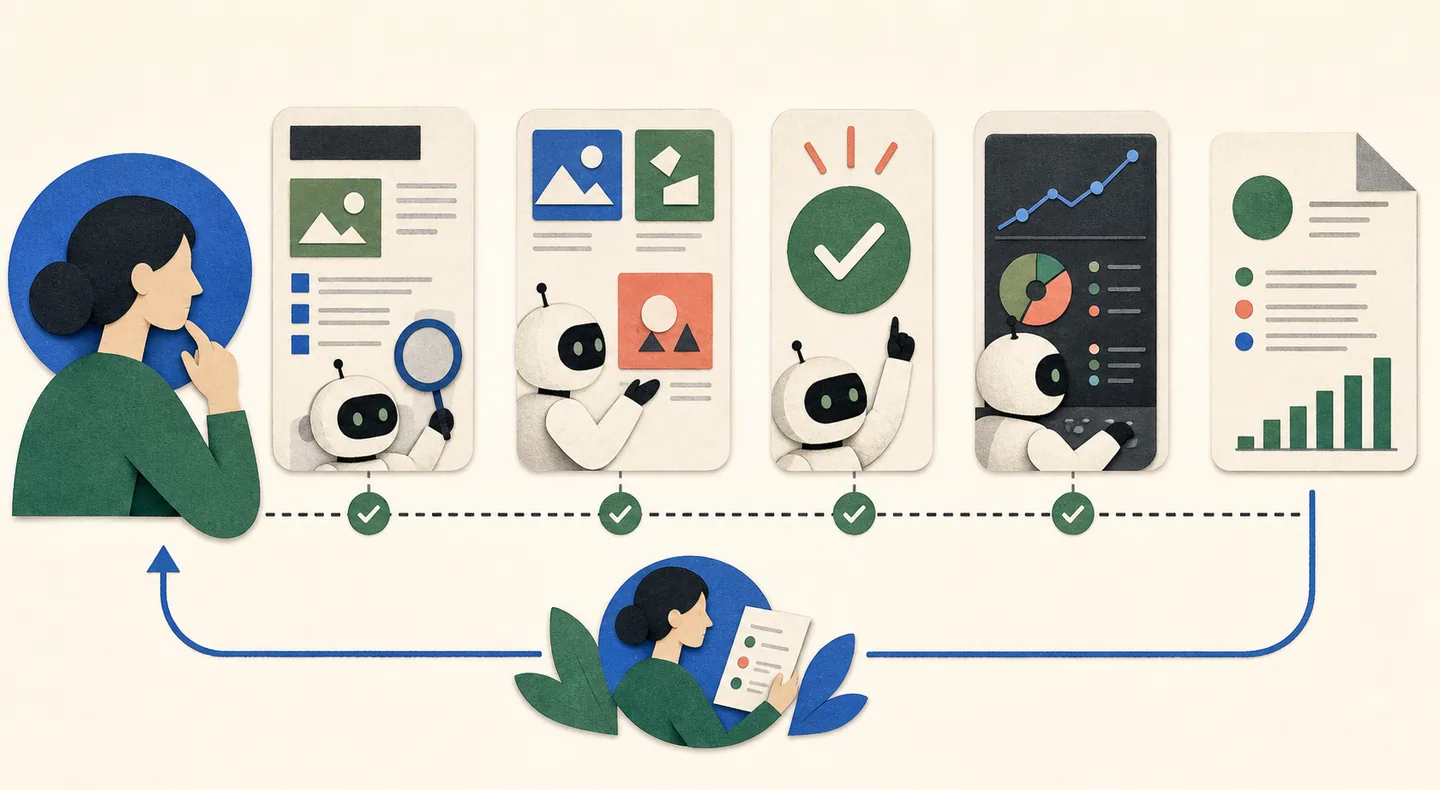
An agent can use these signals to decide when to act and when to gather more data. If confidence is low, it might run a Champion-Challenger A/B test for a more rigorous comparison before making a decision.
Building Your First AI Marketing Agent
Ready to build? Here's how to get started:
- Create a Kettio account and generate an API key from your dashboard.
- Start with the Rank API guide — it's the foundation of every agent workflow.
- Add audience intelligence with our audience research guide.
- Implement A/B testing using the Champion-Challenger guide.
- Connect to Claude with our MCP integration guide for fully autonomous workflows.
Each guide includes full code examples and explains the concepts behind the API so your agent makes better decisions.
Start Building AI Marketing Agents
Get your API key and start scoring creatives in under 5 minutes. 50 free credits included.
Get Your API Key →Frequently Asked Questions
What is AI agent marketing?
AI agent marketing is the use of autonomous AI agents — software that combines LLMs with tool access — to perform marketing tasks like scoring creatives, researching audiences, testing ad variants, and optimizing campaigns. Unlike chatbots that give suggestions, agents take actions through APIs.
How do AI marketing agents score ad creatives?
Agents call application-layer APIs like Kettio's Rank API. Kettio builds a synthetic audience persona from your target demographics, generates multiple independent evaluations using an ensemble of AI models, and returns calibrated scores that correlate with real human preferences. The agent interprets these scores and acts on them.
Do AI marketing agents replace human marketers?
No. AI agents handle the high-volume, repetitive parts of creative testing — scoring dozens of variants, running A/B comparisons, iterating on underperforming ads. Human marketers set strategy, define audiences, provide brand direction, and make final campaign decisions. Agents are tools that make marketers faster.
How accurate is AI ad scoring compared to human panels?
Kettio's SSR pipeline achieves ρ = 0.58+ Spearman correlation with human preferences on academic benchmarks — outperforming GPT-4o in zero-shot evaluation. On advertising-specific images, correlation reaches ρ = 0.67. This is competitive with the inter-annotator agreement among human panelists themselves.
What's the difference between scoring and A/B testing?
Scoring (POST /api/v1/rank) gives each creative an absolute score and ranks them. A/B testing (POST /api/champion-challenger) does a head-to-head comparison using Bradley-Terry pairwise voting with 6 balanced votes. Use scoring for ranking many creatives quickly. Use A/B testing when you need statistical confidence on a specific matchup.
Can I use Kettio with Claude, GPT, or other AI agents?
Yes. Kettio's REST API works with any agent framework. For Claude specifically, Kettio offers an MCP server that gives Claude direct tool access to scoring, generation, and editing without custom API code.
Try it on your ads
Compare your own ads, free.
Upload two static ads, choose your buyer, and get a quick prediction with clear next steps. No signup or credit card.
Find my winning ad →