
Facebook A/B testing, also called split testing in Meta’s Ads Manager, is the most widely used creative testing method for paid social. It’s built into the platform, it’s free to use, and when done correctly it produces statistically valid decisions about which creative, audience, or placement performs better. This guide covers how the tool works, best practices for setting up tests that actually produce clean data, and where the approach breaks down, plus a faster alternative for the situations where A/B testing isn’t practical. (If you just want the fast version: you can compare two Facebook ads free right on this page in about 30 seconds — no ad account, no spend.) Before testing copy variants, it’s worth knowing that ad copy length norms vary 29× by category — a “short vs long” test only makes sense against your own vertical’s baseline.
Quick Answer: How to A/B Test Facebook Ads
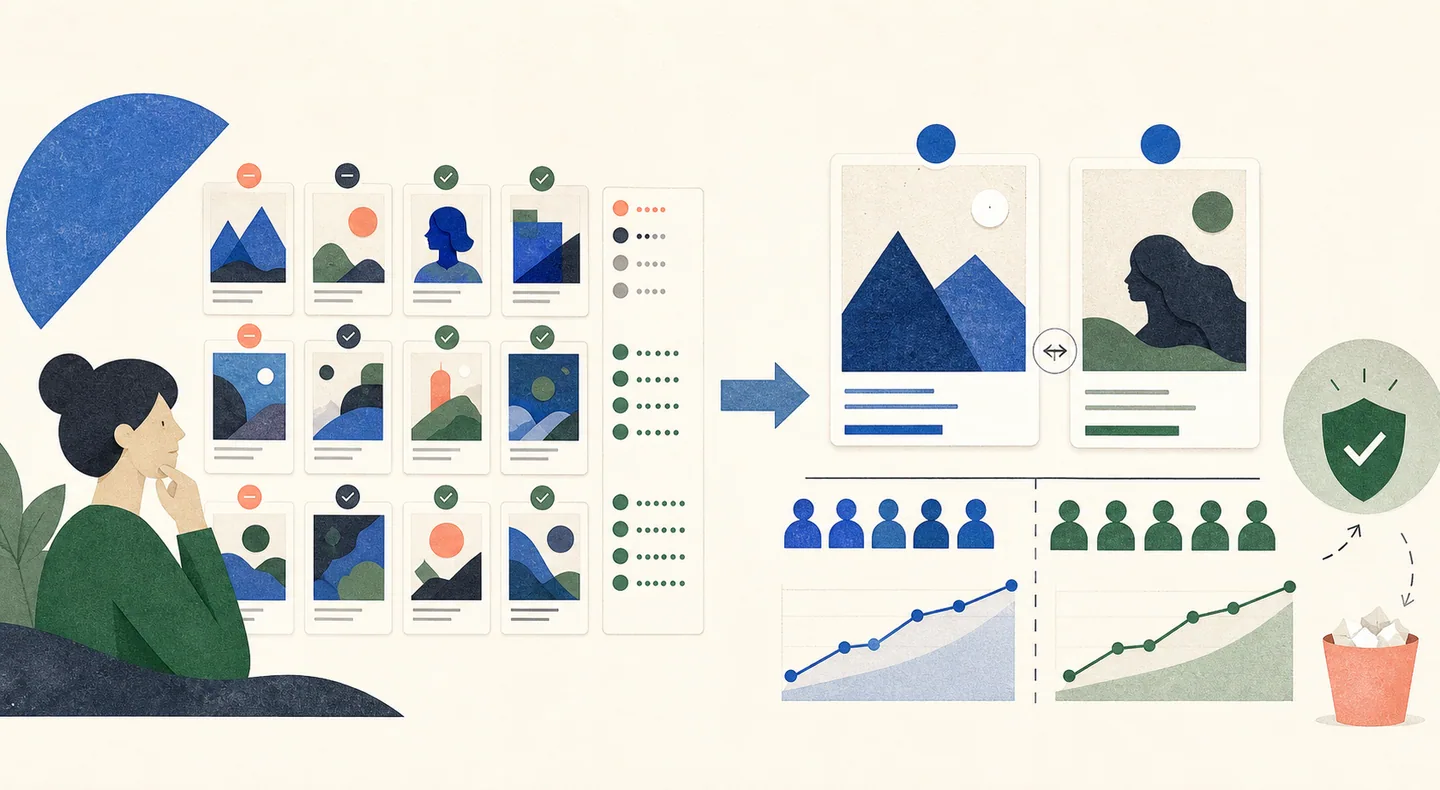
- Pre-screen your variants before spending. Score every draft free with Kettio’s free ad analyzer against the buyer you’re targeting, and keep only the top 2 for the paid test.
- Test one variable. Creative, audience, or placement — never several at once.
- Pick one success metric before launch. Cost per purchase, cost per lead, CTR, or ROAS. Don’t switch after seeing early results.
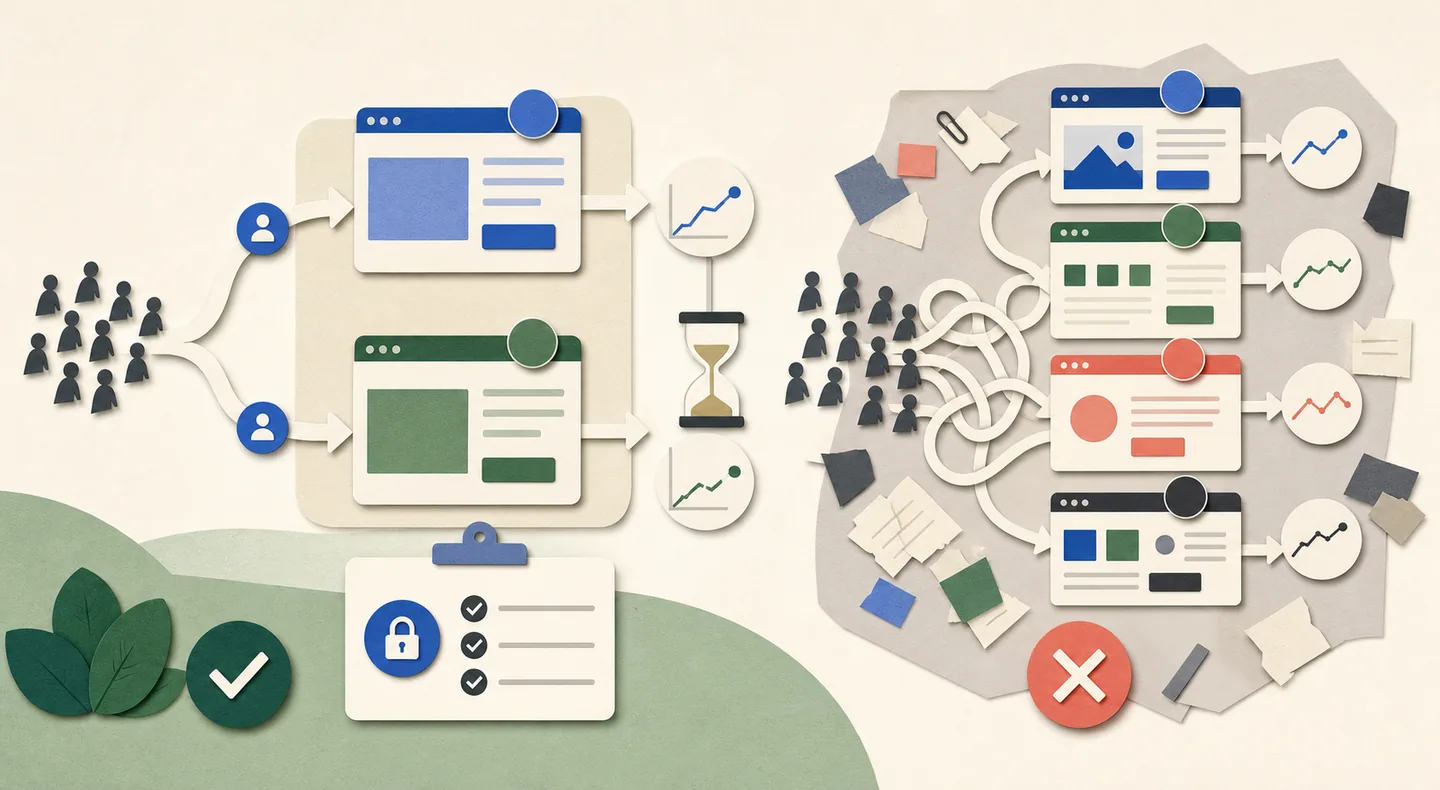
- Use Meta’s built-in A/B test in Ads Manager so no person sees both variants.
- Fund it properly. Most credible tests need $50–$100 per day per variant to reach significance.
- Run a full buying cycle. Typically 7–14 days; don’t call a winner on day 3.
- Scale the winner, then brief the next round from what the pre-launch rationales said about why it won.
How Facebook’s A/B Testing Tool Works
Meta’s split testing Facebook ads feature divides your audience into non-overlapping groups and serves each group a different version of your ad. Unlike running two campaigns simultaneously and eyeballing the results, the built-in A/B test ensures no person sees both variants, which eliminates the audience overlap problem that makes informal tests unreliable.
You can test one variable at a time: creative (image, video, copy, headline), audience (targeting parameters), or placement (Facebook vs. Instagram vs. Reels). Meta recommends testing one variable per experiment for clean, interpretable results.
The test runs until it reaches statistical significance or hits your end date. Meta surfaces a winner notification in Ads Manager and gives you a confidence percentage. The minimum recommended budget depends on your cost-per-result, but Meta’s own guidance suggests a minimum of $1,000 across the test to get reliable results.
Setting Up a Facebook Ad Test That Actually Works
Most Facebook ad testing fails not because the tool is bad but because the test is set up wrong. Here are the variables that actually matter.
Test one thing at a time. This is the most violated rule in split testing Facebook ads. If you change the creative AND the audience AND the placement, you don’t know which change drove the result. Pick the variable with the most uncertainty. Test it. Move on.
Define your success metric before you start. Cost per purchase, cost per lead, CTR, ROAS: pick one. The test that optimizes for clicks often looks different from the test that optimizes for purchases. Changing your metric after seeing early results is how you fool yourself into a false positive.
Let the test run to completion. Early data in Facebook A/B tests is unreliable. The algorithm is still learning. The audience distribution is uneven. Looking at results on day 3 of a planned 14-day test and making decisions based on what you see is a common and expensive mistake.
Match test duration to your buying cycle. If your product has a 7-day consideration window, a 3-day test will miss conversions that belong to your first-day impressions. A rule of thumb: run tests for at least one full buying cycle plus a few days of buffer.
When the Facebook A/B Testing Tool Has Real Limits
The built-in Facebook ad testing tool works well at scale. For teams with consistent monthly spend above $10,000, the statistical infrastructure is there. But it has structural limits that show up frequently in practice.
It requires real spend to generate data. You can’t test a concept before you launch it. The test itself is the spend. If you’re running a new product launch and you don’t know whether any of your creatives will resonate, you’re paying to find out. For niche audiences with limited reach, the test might never reach significance at all.
It takes weeks. A properly structured Facebook ab testing experiment with statistical confidence typically takes 2 to 4 weeks. In a fast-moving campaign calendar, that’s a significant lag.
It only tests what you’ve already built. Facebook’s tool tells you which of your existing creatives wins. It doesn’t tell you why, and it doesn’t help you build a better version. You get a winner, not a direction.
The Faster Alternative: Pre-Launch Testing
For the situations where Facebook A/B testing is too slow, too expensive, or simply not practical, pre-launch testing is the alternative. Instead of spending to learn which creative wins, you test your variants against synthetic audience personas before you launch and only spend on the predicted winner.
Kettio’s Facebook ad testing workflow works like this: you upload the creative variants you’ve developed, define your target audience (the same parameters you’d set in Ads Manager: age, interests, purchase behavior, price sensitivity), and Kettio runs them through synthetic personas built to represent that buyer. You get a ranked list with rationales explaining why each persona responded the way they did.
Free, no ad account needed
Which of your two ads would the buyer pick?
Drop two versions you’re about to test. A simulated buyer reads each one and says how close it gets them to buying. It takes about 30 seconds.
Who’s the buyer?
Never heard of you · 25–34 · scrolling, not shopping
Scored on purchase intent for a Meta feed ad.
This doesn’t replace Facebook’s A/B test for campaigns that already have budget and runway. What it replaces is the guess you make before you launch: the internal review meeting where you pick 2 of your 10 variants based on team preference. Replace that guess with a pre-launch test on Kettio, then use Facebook’s tool to validate and optimize once you’re live.
For a broader look at the alternative to spend-to-learn testing, read why A/B testing is getting replaced by pre-launch AI testing. And if you’re generating your variants with AI tools before testing, see our guide on how to test AI generated ad creatives.
The Best Setup in 2026
The best-performing teams aren’t choosing between Facebook A/B testing and pre-launch testing. They’re using both: pre-launch testing to narrow 10 variants down to 2 strong candidates, then Facebook’s A/B tool to validate the winner with real audience data at scale.
Pre-launch testing cuts your A/B test budget in half (you’re running 2 variants, not 5). It reduces the time to a confident decision. And the rationales you get from pre-launch testing give you a creative brief for improving the winner before you scale.
Pre-launch testing doesn’t replace Facebook’s built-in tools — it makes them cheaper to use correctly. You’re running 2 validated contenders through the A/B tool instead of 5 unknowns. The test gets there faster, costs less, and you already know going in that both variants have a real shot.
Frequently asked questions
How does Facebook A/B testing work in 2026?
Facebook A/B testing (split testing in Meta Ads Manager) randomly assigns audience members to variants, runs them in parallel for a set duration, and measures statistical significance on a chosen KPI like cost-per-result, CTR, or ROAS. The tool is free and built into Ads Manager, but it requires real media spend, weeks of runtime, and statistically significant sample sizes to produce a confident decision.
What is the minimum budget for a Facebook A/B test?
Most credible Facebook A/B tests need at least $50–$100 per day per variant to reach significance within 7–14 days. Below that, tests rarely accumulate enough conversions for the result to be statistically valid. Teams under $3,000/month total ad spend often run tests that never reach significance — a common failure mode that creates false confidence.
How long should a Facebook A/B test run?
Run tests for at least one full buying cycle plus a few days of buffer — typically 7 to 14 days. For longer consideration windows or higher-priced products, extend to 21–28 days. Don't end tests early based on directional data on day 3; the algorithm is still in its learning phase and audience distributions are uneven.
Can you test Facebook ads without spending money?
Yes. Pre-launch testing platforms like Kettio score ad variants against synthetic audience personas before you spend on media. You upload your creative variants, define your target audience, and get a ranked prediction in roughly 30 seconds. Validated against University of Washington survey panels at Spearman ρ = 0.78 and 70.3% pairwise agreement with real CTR labels on the CreativeRanking benchmark.
Is Facebook A/B testing being replaced by AI?
No — they are complementary. The best 2026 setup uses pre-launch AI testing to narrow 10 variants down to 2 strong candidates, then runs Facebook's built-in A/B test to validate the winner with real audience data at scale. AI testing makes A/B testing cheaper by reducing the number of unknowns going in.
Try it on your ads
Compare your own ads, free.
Upload two static ads, choose your buyer, and get a quick prediction with clear next steps. No signup or credit card.
Find my winning ad →