
Predicting ad performance before launch does not mean producing a guaranteed CTR, CPA, ROAS, or revenue number. It means gathering enough relevant evidence to decide which creative concepts deserve the next live test.
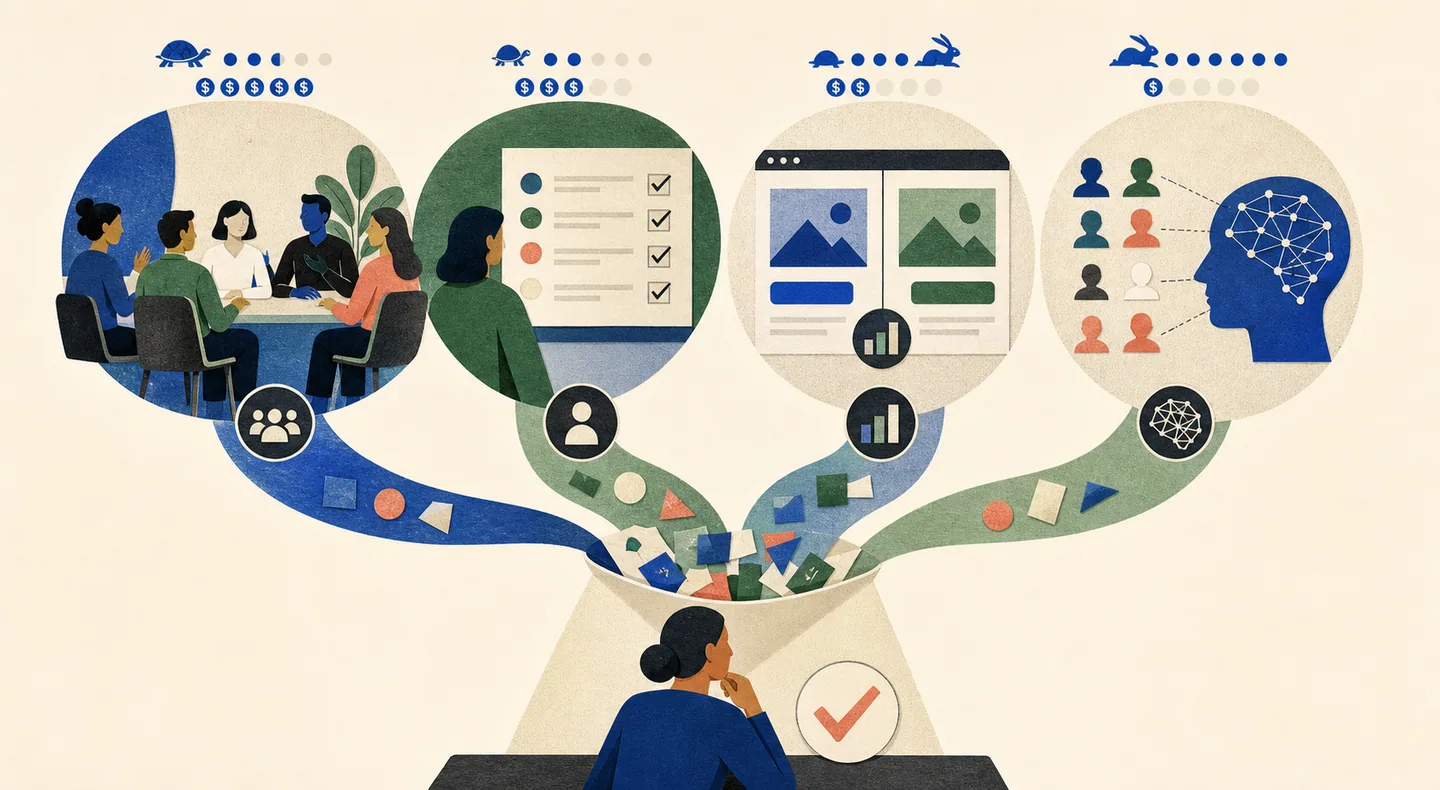
This guide compares four practical evidence sources: expert review, research panels, pre-launch model scoring, and live controlled tests. Each answers a different question, and each fails when it is asked to prove more than it measures.
Method 1: Focus Groups
The original pre-launch testing method. You recruit participants who match your target audience, show them your creative concepts, and collect qualitative feedback in a moderated session.
What it costs: $5,000–$15,000 per round. Six to eight weeks from briefing to results. You’ll run two to three rounds before launch for a meaningful campaign.
Where it breaks down: Focus groups suffer from social desirability bias (people say what sounds reasonable, not what they’d actually do), groupthink (one strong personality dominates the room), and selection bias (people who volunteer for focus groups aren’t representative of people who ignore ads). Most importantly: what people say in a controlled discussion environment doesn’t predict how they’ll behave when an ad interrupts their TikTok scroll at 11pm.
Focus groups are good for early concept exploration. They’re a poor proxy for performance prediction.
Method 2: Survey Panels
Survey panels (Kantar, Ipsos, Nielsen, Qualtrics) expose your creative to a panel of respondents and measure stated metrics: recall, brand lift, purchase intent, message clarity. More structured than focus groups. Faster. Statistically cleaner.
What it costs: $3,000–$20,000 per study depending on sample size and panel quality. Two to four weeks turnaround.
Where it breaks down: Surveys measure stated preference, not revealed preference. Asking someone “would you buy this after seeing this ad?” measures their self-image as a consumer more than their actual purchase likelihood. Survey responses also correlate poorly with click-through rates, the metric most performance marketers actually care about. You can run a survey, get high purchase intent scores, launch the campaign, and watch it bomb.
Survey panels are useful for brand health tracking and regulatory compliance testing. For performance creative decisions, the signal-to-noise ratio is mediocre.
Method 3: A/B Testing (In-Platform)
Launch both variants simultaneously, split your audience, and let real performance data determine the winner. The most direct measurement possible: you’re measuring what actually happens, not what people say will happen.
What it costs: The media budget required to reach statistical significance. For a typical DTC brand testing two creatives at $10 CPC, you need roughly 200–400 clicks per variant to detect a 20% difference in CTR with 80% power. That’s $2,000–$4,000 in minimum test spend, assuming decent traffic. Scale up to testing six creatives and the numbers multiply.
Where it breaks down: A/B testing is the gold standard for confirming a winner, but it’s a terrible discovery mechanism. The learning phase costs money. Losers run on your budget. And by the time you have statistical significance, the campaign window may have passed. For brands refreshing creative every two to four weeks, in-platform A/B testing simply can’t keep pace with production.
For a deeper look at why in-flight testing has structural limits, see why A/B testing is dead.
Method 4: Synthetic Audience Testing
This is the fourth method, and the one that actually scales. Instead of recruiting humans or spending media budget, you build a digital model of your target audience and evaluate your creatives against it before launch.
The approach uses AI to simulate how your target buyer responds to each creative variant. It’s not asking a model to guess what a demographic would think. It’s grounding the simulation in real behavioral data and validating against known outcomes. Kettio’s system scored 1,089 real ads on an academic benchmark and outperformed GPT-4o zero-shot.
What it costs: A fraction of a focus group or survey panel. No media budget. Results in minutes, not weeks.
Where it breaks down: Synthetic testing is best for ranking relative performance across variants, predicting which creative will outperform others within a campaign. It’s less suited for absolute benchmarks (“will this ad hit a 3% CTR?”) or for highly novel creative formats with no training analogs. And like all prediction systems, it requires validation against real outcomes over time to stay calibrated.

How Kettio Works, Step by Step
If you’re new to synthetic testing, here’s the actual workflow on Kettio:
- Upload your creatives. Drop in your image variants, video thumbnails, or static ad files. You can test as few as two or as many as 20 at once.
- Define your audience. Specify your target buyer: demographics, platform, purchase intent context. Kettio builds a grounded synthetic representation, not a prompt-engineered persona, but a validated audience model.
- Run the evaluation. Kettio’s SSR pipeline evaluates each creative against your audience model and produces a ranked list with scores and qualitative explanations.
- Read the output. You get a ranked list of creatives with predicted performance scores, plus the specific elements that drove each score up or down. Not just “Creative A wins” but “Creative A wins because the headline directly addresses the pain point your audience cares about.”
- Launch with confidence. Take the winners to your ad platform. Use the losers’ explanations to brief your next creative iteration.
The whole process takes minutes. A focus group takes months. An A/B test takes weeks. Synthetic testing’s speed advantage compounds over time: teams that can evaluate a new batch of creatives in minutes iterate faster, learn faster, and build better creative intuition faster than teams waiting on survey results.
Combining Methods
The smartest creative testing programs don’t pick one method. They use methods in sequence. Synthetic testing for rapid elimination (cut 80% of variants before any spend), A/B testing for final confirmation (validate the top two or three with real data), and survey panels for brand-level health checks (quarterly, not per-campaign).
The goal is to spend your A/B testing budget on known contenders, not on exploratory elimination. Synthetic testing handles the elimination. Real data handles the confirmation. That’s the workflow that scales.
If the goal is to spend your A/B testing budget on known contenders rather than on exploratory elimination, synthetic testing handles the elimination. The question is how many test cycles you want to run before that becomes the default workflow.
Try it on your ads
Compare your own ads, free.
Upload two static ads, choose your buyer, and get a quick prediction with clear next steps. No signup or credit card.
Find my winning ad →