
On this page10 sections
- The Trust-Building Flow: From Ad to Purchase
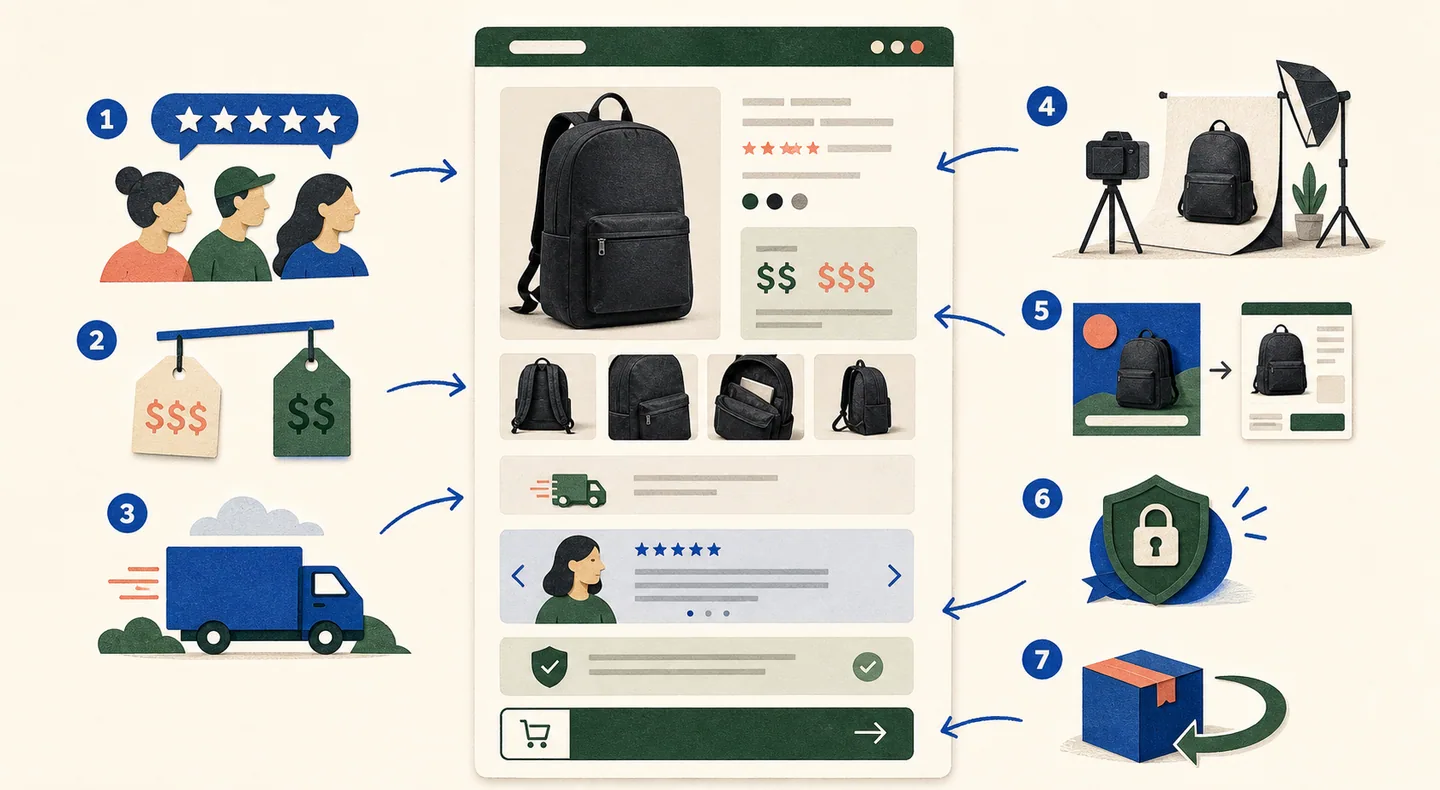
- Trust Signal #1: Social Proof That Actually Converts
- Trust Signal #2: Price Anchoring That Feels Fair
- Trust Signal #3: Shipping & Returns Clarity
- Trust Signal #4: Product Photography That Sells
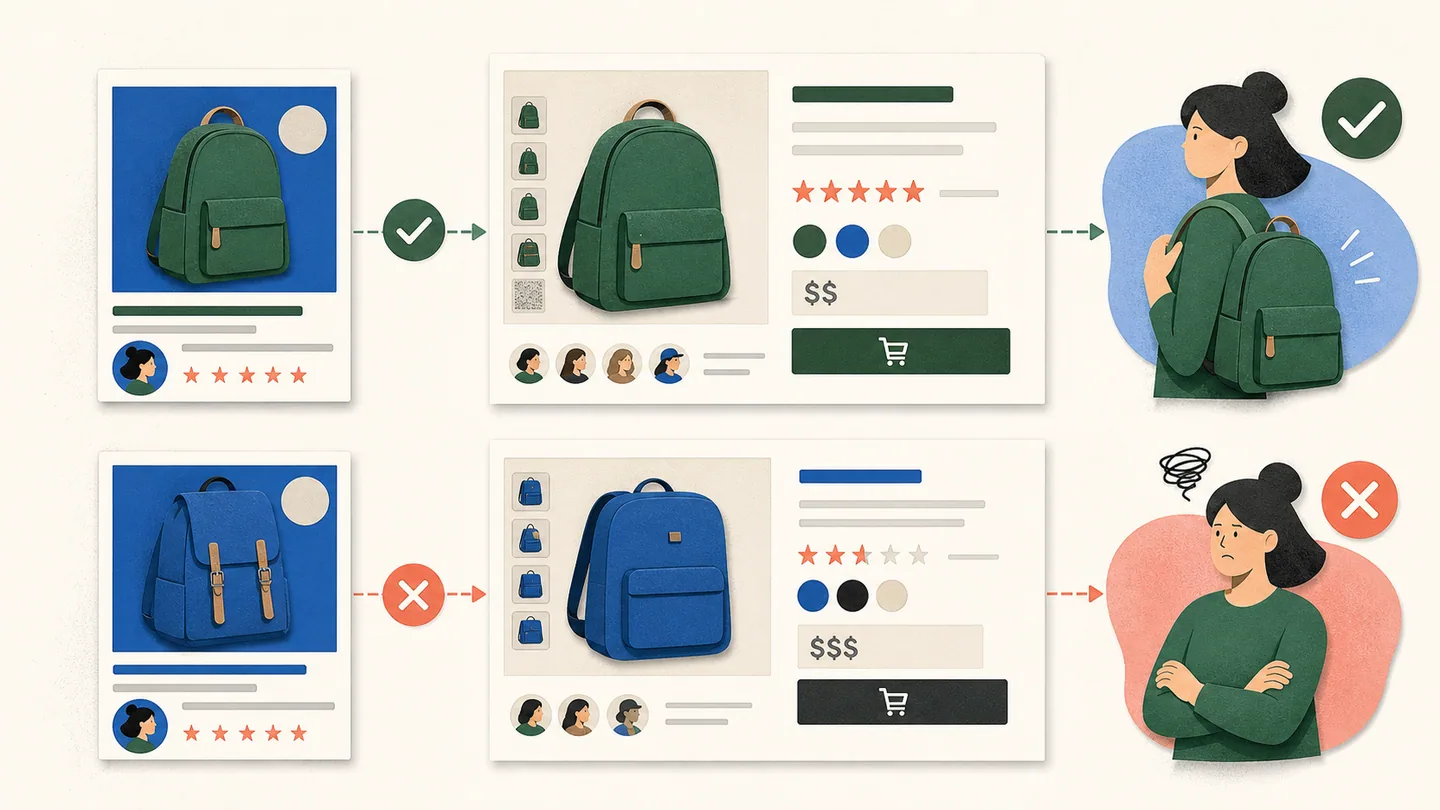
- Trust Signal #5: Title & Description Alignment With Your Ad
- Trust Signal #6: Urgency and Scarcity (Done Right)
- Trust Signal #7: Mobile-First Layout
- The Product Page Scoring Rubric
- The Bottom Line
TikTok sends you traffic unlike any other platform.
These aren’t people who searched for your product. They’re not returning customers who already trust your brand. They’re impulse visitors—scrolling through entertainment, suddenly intrigued by a 15-second video, and clicking through to a product page they’ve never seen before from a brand they’ve never heard of.
This is the trust gap problem. TikTok’s algorithm does the hard work of getting eyes on your content. But those eyes arrive skeptical. Every single one of them is asking the same question: “Should I trust this brand with my money?”
The data is stark. 97% of consumers express concerns about shopping on unfamiliar websites. 90% worry about identity theft while shopping online. 70% actively look for trust signals before completing a purchase. And when trust signals are used effectively, they can boost conversion rates by up to 20%.
Your product page has one job: close the trust gap before the visitor scrolls back to TikTok.
The Trust-Building Flow: From Ad to Purchase
Understanding the trust gap requires mapping the journey your TikTok visitors take. Each stage either builds confidence or creates friction. For a deeper look at where this funnel breaks down, see the five failure points killing TikTok Shop conversions.
flowchart LR
    A["TikTok Ad/Video"] --> B{"Thumbnail Stops Scroll?"}
    B -->|Yes| C["Hook Engages"]
    B -->|No| X["Lost"]
    C --> D["Click to Product Page"]
    D --> E{"Trust Signals Present?"}
    E -->|Yes| F["Add to Cart"]
    E -->|No| Y["Bounce"]
    F --> G["Checkout Complete"]

    style A fill:#e1f5ff,color:#333,stroke:#e1f5ff
    style G fill:#d4edda,color:#333,stroke:#d4edda
    style X fill:#ff6b6b,color:#fff,stroke:#ff6b6b
    style Y fill:#ff6b6b,color:#fff,stroke:#ff6b6b
The trust gap opens the moment someone clicks from TikTok to your product page. They’re no longer in the entertainment zone—they’re in evaluation mode. Every element on your page either answers their unspoken questions or adds to their hesitation.
The good news: trust signals are systematic. You can implement them. You can test them. And when you get them right, TikTok’s impulse traffic converts at rates that rival warm traffic from any other source.
Trust Signal #1: Social Proof That Actually Converts
Social proof is the most powerful trust signal on your product page. Not because it tells visitors your product is good—because it shows them that people like them have already bought and been satisfied.
The data:
- 90% of shoppers read reviews before buying
- Products with 10+ reviews see a 45% conversion lift
- Products with customer photos/videos convert 74% higher than those without
- 40% of shoppers rate UGC as “extremely” or “very” important in purchase decisions
- 13% have abandoned a sale because there wasn’t any user-generated content
What effective social proof looks like:
Review count and rating: Display prominently near the product title. A 4.5-star rating with 200+ reviews performs better than a perfect 5.0 with 12 reviews—balanced feedback builds more confidence than suspicious perfection.
UGC photos and videos: Real customers showing real results. A photo of someone actually wearing the dress, using the gadget, or displaying the results. This is 3x more effective than studio photography at driving conversions.
Review content quality: Recent reviews matter more than old ones. Detailed reviews mentioning specific features, timelines, or use cases outperform generic “great product!” comments. TikTok’s algorithm also prioritizes listings with frequent, recent reviews in search results.
The implementation:
- Feature your review count and average rating above the fold
- Include a UGC gallery with customer-submitted photos/videos
- Display 3–5 detailed recent reviews, not just star ratings
- Show seller response activity—TikTok displays this and it impacts perceived legitimacy
Here’s where most sellers miss the mark: They collect reviews but bury them at the bottom of the page. Or they show only star averages without the actual review content. Or they have reviews but no visual proof. Social proof only works if visitors actually see it.
Surface the gaps you can’t see yourself: Run your product page through Kettio’s synthetic shopper testing and ask specifically about trust signals. The feedback will surface gaps you didn’t know existed: “I see 50 reviews but no photos of real people using it” or “The reviews are all from 6 months ago—does anyone still buy this?” Fix the gaps before you spend on traffic.
Trust Signal #2: Price Anchoring That Feels Fair
Price is never just a number. It’s a perception. And perception is shaped by context.
The psychology:
Price anchoring works because humans evaluate prices relatively, not absolutely. The first price we see becomes our reference point. Everything after that is judged as better or worse than that anchor.
Effective price anchoring tactics:
Was/now pricing: Show the original price crossed out next to the sale price. “$80 → $35” doesn’t just communicate a discount—it creates a value perception. The $80 anchor makes $35 feel like a win, even if the visitor had no prior expectation of what the product should cost.
Competitor comparisons: “Similar serums sell for $60+ at Sephora. This does the same thing for $24.99.” This establishes an external anchor from a trusted source, making your price feel like discovered value.
Bundle savings: “Complete 3-Step Kit: $45 (value $75 if purchased separately).” The individual prices anchor the bundle value. TikTok audiences respond exceptionally well to bundles that feel like “hacks.”
Tiered options: Present three price points—basic, standard, premium. Most customers gravitate toward the middle option, which should be your target price point. The premium tier anchors the middle as reasonable.
The catch: Aggressive discounting too early signals low quality to TikTok’s algorithm, which may devalue listings that appear “clearance only.” And fake anchors—showing an inflated “was” price that was never real—destroy trust when customers catch on.
Test your price framing: Run two price presentations against synthetic shoppers—“$24.99” versus “$24.99 (comparable products: $60+)”—and see which one drives higher purchase intent. The same price can convert wildly differently depending on how you frame it.
Trust Signal #3: Shipping & Returns Clarity
Uncertainty kills conversions. And nothing creates uncertainty like not knowing what happens after you click “buy.”
The data:
- 67% of buyers check return policies before purchasing
- Adding a “30-day money-back guarantee” badge led to a 32% increase in sales in one study
- Free shipping offers can reduce cart abandonment by up to 30%
- 49% of shoppers see the absence of trust badges as a red flag for potential fraud
What clarity looks like:
Shipping information:
- “Free shipping on orders over $35”—clear threshold, clear benefit
- “Ships within 24 hours” or “Delivered in 3–5 business days”—specific timeline
- “Fulfilled by TikTok” badge—if applicable, this increases conversion from 3.8% to 6.1%
Return policy:
- “Free 30-day returns”—simple, visible, no fine print required to understand
- “No questions asked” or “Hassle-free”—reduces perceived friction
- Display this near the add-to-cart button, not buried in footer links
The placement rule: Shipping and returns information should be visible without scrolling on mobile. Remember: 54% of global web traffic is mobile, and TikTok traffic skews even higher. If visitors have to hunt for this information, many will bounce before they find it.
There’s a shortcut most sellers miss: When you run your product page through synthetic shopper testing, the feedback often surfaces shipping and returns concerns unprompted: “I can’t tell when this would ship” or “What if it doesn’t fit?” These are the exact hesitations killing your conversions. Address them visibly.
Trust Signal #4: Product Photography That Sells
Your product images do more than show what you’re selling. They signal quality, professionalism, and whether customers can trust what they’ll receive.
The photography decision:
| Style | Best For | Conversion Impact |
|---|---|---|
| White background | Marketplaces, clarity, comparison shopping | High for functional products |
| Lifestyle | Social media, emotional connection, aspiration | High for fashion, home, beauty |
| Both | Most effective approach | Highest overall |
White background photography:
- Shows product details clearly without distraction
- Meets marketplace requirements (Amazon, TikTok Shop)
- Reduces cognitive load—shoppers quickly understand what they’re viewing
- Best for: electronics, gadgets, products where specifications matter
Lifestyle photography:
- Shows product in context—being used, worn, displayed
- Creates emotional connection and aspiration
- Helps customers imagine the product in their own lives
- Best for: fashion, beauty, home goods, fitness
The winning formula: Use both. Lead with lifestyle images that create desire, follow with white-background images that provide clarity. TikTok’s visual search algorithm prioritizes lifestyle images, but shoppers still want to see clear product details before buying.
Image requirements:
- Minimum 4–6 high-resolution images
- Include one “in-use” or demonstration image
- Show product from multiple angles
- Include close-ups of important details
- For variants (colors, sizes), show the actual variant, not just a swatch
The faster path to the right imagery: Test different image sequencing—lifestyle-first versus product-first—against synthetic shoppers. Kettio shows you which visual approach creates stronger purchase intent for your specific product category.
Trust Signal #5: Title & Description Alignment With Your Ad
This is where most TikTok Shop sellers lose sales they should have won. Your hook sets an expectation. Your product listing must deliver on it.
The mismatch that kills sales:
Your TikTok video promises: “This vitamin C serum faded my dark spots in 3 weeks.”
Your product title: “Vitamin C Serum - 15% L-Ascorbic Acid - 1oz”
Your description: Lists ingredients, no mention of dark spots, no timeline, no before/after imagery.
The viewer clicked expecting validation of a specific promise. Instead, they found a generic product page. The disconnect kills conversion.
TikTok Shop SEO best practices:
Title format: [Brand] + [Product] + [Application] + [Type] + [Key Features]
Example: “GlowRx Vitamin C Serum - Dark Spot Corrector - Brightening Treatment with Hyaluronic Acid”
Title guidelines:
- Keep under 80 characters (TikTok truncates longer titles)
- Lead with benefit, not just product name
- Include searchable keywords TikTok indexes
- Avoid filler like “Hot Item” or emoji spam—TikTok downgrades clickbaity titles
Description best practices:
- Minimum 500 characters
- Hook: Fast, emotional opener that matches your video promise
- Proof: Specific details that validate the claim
- Trust: Validation (reviews, certifications, guarantees)
- CTA: Clear next step
Example structure:
“The viral dark spot serum dermatologists swear by—now with over 50,000 verified reviews. Our 15% vitamin C formula with ferulic acid visibly fades dark spots and hyperpigmentation in as little as 3 weeks. Developed with board-certified dermatologists. Cruelty-free, fragrance-free, suitable for sensitive skin. Tap ‘Buy Now’ for same-day dispatch and free 30-day returns.”
The alignment test: Upload your video creative and product listing side by side in Kettio. Synthetic shoppers will tell you if your listing delivers on your video’s promise. If the feedback says “the video made me expect before/after photos but the listing is just ingredient specs”—you found your leak.
Trust Signal #6: Urgency and Scarcity (Done Right)
Urgency and scarcity work because they tap into loss aversion—the psychological bias where we feel losses more intensely than equivalent gains. But there’s a thin line between effective urgency and spammy desperation.
What works:
Genuine scarcity:
- “Only 12 left in stock”—when it’s actually true
- “Limited edition—won’t be restocked”—for actual limited releases
- “Flash sale ends in 4 hours”—with a real, non-resetting timer
Social proof + urgency:
- “Sarah from Austin just purchased this”
- “23 people are viewing this item right now”
- “Sold out 3 times last week—back in stock now”
What doesn’t work (the spammy stuff):
- Fake countdown timers that reset on refresh
- “Only 3 left!” when you have 3,000 in inventory
- “Last chance!” emails sent every Tuesday
- Urgency without value—pressure without a reason to buy
The rule: Urgency accelerates decisions. It doesn’t create them. If your product doesn’t have clear value, all the timers and FOMO in the world won’t fix it. But when value is established, urgency can increase conversion rates by up to 30%.
The cadence: Don’t train customers to wait for the next deal. If every week is a flash sale, you create a pattern, not urgency. Use scarcity for:
- Product launches
- Actual inventory limitations
- Seasonal promotions
- Special events
Test your urgency messaging: Run urgency variations against synthetic shoppers to see which creates genuine “I should act now” feelings versus eye-rolling skepticism. Feedback like “this feels like a real limited offer” versus “yeah right, they’ll have this sale again next week” tells you everything.
Trust Signal #7: Mobile-First Layout
Here’s the reality: 54% of global web traffic comes from mobile devices. For TikTok traffic, that number is closer to 80–90%. If your product page isn’t designed for mobile-first, you’re losing sales before visitors even see your trust signals.
Mobile UX requirements:
Thumb-friendly design:
- Touch targets minimum 44×44 pixels (Apple’s recommendation)
- Primary CTA (Add to Cart) within thumb reach—bottom of screen
- 8–10 pixels spacing between interactive elements
- No tiny buttons that require precision tapping
Fast loading:
- Images optimized for mobile (compressed, lazy-loaded)
- Minimal HTTP requests
- Above-the-fold content loads in under 3 seconds
Readable without zooming:
- Text large enough to read without pinch-zooming
- No horizontal scrolling
- Product images zoomable with pinch gesture
- Clear visual hierarchy—most important info first
Simplified navigation:
- Bottom navigation bars work better than hamburger menus
- Clear path from product page to cart to checkout
- Progress indicators during checkout
- Guest checkout option (don’t force account creation)
The mobile trust gap: Mobile shoppers have less patience and more hesitation. They can’t easily open multiple tabs to compare. They can’t hover over elements for more information. Every friction point is magnified. Your mobile product page needs to be cleaner, faster, and more reassuring than your desktop version.
Test where your traffic actually lives: Test your product page on actual mobile devices, not just browser emulators. Better yet, run it through Kettio’s synthetic shopper testing with mobile-first evaluation criteria. Feedback like “the add to cart button is too small” or “I have to scroll too much to find shipping info” are conversion killers you can fix.
The Product Page Scoring Rubric
Use this rubric to audit your own product pages. Score each element 0–3, then total your score.
| Trust Signal | 0 (Missing) | 1 (Weak) | 2 (Good) | 3 (Excellent) |
|---|---|---|---|---|
| Social Proof | No reviews | Few reviews, no UGC | Reviews + some UGC | 50+ reviews, UGC gallery, recent activity |
| Price Anchoring | Price only | Basic discount shown | Was/now + competitor compare | Multiple anchors, bundle options |
| Shipping/Returns | Not mentioned | Buried in footer | Visible, clear policy | Prominent badges, specific timelines |
| Photography | 1–2 images, one style | 3 images, basic quality | 4–5 images, mixed styles | 6+ images, lifestyle + white bg, zoomable |
| Title/Description | Generic, no keywords | Basic info, some keywords | Optimized, benefit-focused | SEO-optimized, matches ad promise |
| Urgency/Scarcity | None | Fake/always-on urgency | Genuine limited offers | Strategic urgency + social proof |
| Mobile UX | Desktop-only design | Poor mobile experience | Functional mobile | Mobile-first, thumb-friendly, fast |
Score interpretation:
- 0–7: Critical gaps. Expect high bounce rates and low conversion.
- 8–14: Functional but unoptimized. Room for significant improvement.
- 15–18: Strong foundation. Minor optimizations can drive meaningful gains.
- 19–21: Excellent. You’re likely outperforming most competitors.
The Bottom Line
TikTok sends you the hardest-to-convert traffic on the internet: impulse visitors who’ve never heard of your brand, scrolling through entertainment, suddenly considering a purchase.
Your product page has to close the trust gap in seconds. Every element either builds confidence or creates hesitation. The seven trust signals aren’t optional extras—they’re the difference between a TikTok visitor who bounces and one who buys.
Social proof validates your claims. Price anchoring frames your value. Shipping and returns clarity removes uncertainty. Photography creates desire and provides clarity. Title and description alignment delivers on your ad’s promise. Urgency accelerates decisions. Mobile-first design ensures all of this actually works where your traffic lives.
Get these right, and TikTok’s impulse traffic becomes your highest-ROI acquisition channel. Get them wrong, and you’re just funding TikTok’s ad business with nothing to show for it.
🏪 Connect Your TikTok Shop
Kettio’s TikTok Shop tool audits your product pages for trust signals, scores your images and copy, and shows you exactly where buyers drop off.
Stop leaking sales to the trust gap. Test your product page against synthetic shoppers who think like your buyers—and fix the exact friction points killing your conversions.
Frequently asked questions
Why does TikTok traffic convert worse than Google or Facebook?
TikTok sends impulse traffic from users who weren't shopping when they saw your ad. They have no prior brand awareness, they're in entertainment mode, and they bounce within 3–5 seconds if the product page doesn't answer "is this real, is it for me, can I trust them" instantly. Google and Facebook traffic usually arrives with stronger purchase intent and higher trust baseline.
What are the most important trust signals for a TikTok product page?
In order of impact: (1) social proof — reviews with photos, star count, recent review velocity; (2) price anchoring — visible MSRP next to your price; (3) shipping and returns clarity — free returns, delivery date, no surprises; (4) lifestyle photography that matches the ad; (5) clear title/description alignment with the ad copy; (6) urgency without lying — real stock counts, real time windows; (7) mobile-first design that loads fast and works thumb-friendly.
How fast does a TikTok product page need to load?
Under 2 seconds on mobile 4G. TikTok shoppers are coming from an app that runs at 60fps with no perceptible loading anywhere. A 4-second product page feels broken. Target Largest Contentful Paint under 2.0s and Time-to-Interactive under 3.5s — these are the thresholds where bounce rate flatlines.
Does video on the product page actually help conversion?
Yes, when the video matches the ad creative. TikTok shoppers expect continuity — the product page video should pick up where the ad left off, show the product in motion, demonstrate the benefit, and last 15–30 seconds. Auto-play muted with captions. Stock or generic product videos hurt more than they help.
How do I audit my TikTok product page for these trust signals?
Use the 21-point scoring rubric (3 points per signal × 7 signals). Score 0–7 means critical gaps. 8–14 is functional but unoptimized. 15–18 is a strong foundation. 19–21 means you're likely outperforming most competitors. Synthetic-audience platforms like Kettio can also score your page against simulated TikTok shoppers to identify which specific friction point is killing conversion.
Try it on your ads
Compare your own ads, free.
Upload two static ads, choose your buyer, and get a quick prediction with clear next steps. No signup or credit card.
Find my winning ad →