
On this page13 sections
- The Anatomy of a Scroll-Stopping Hook
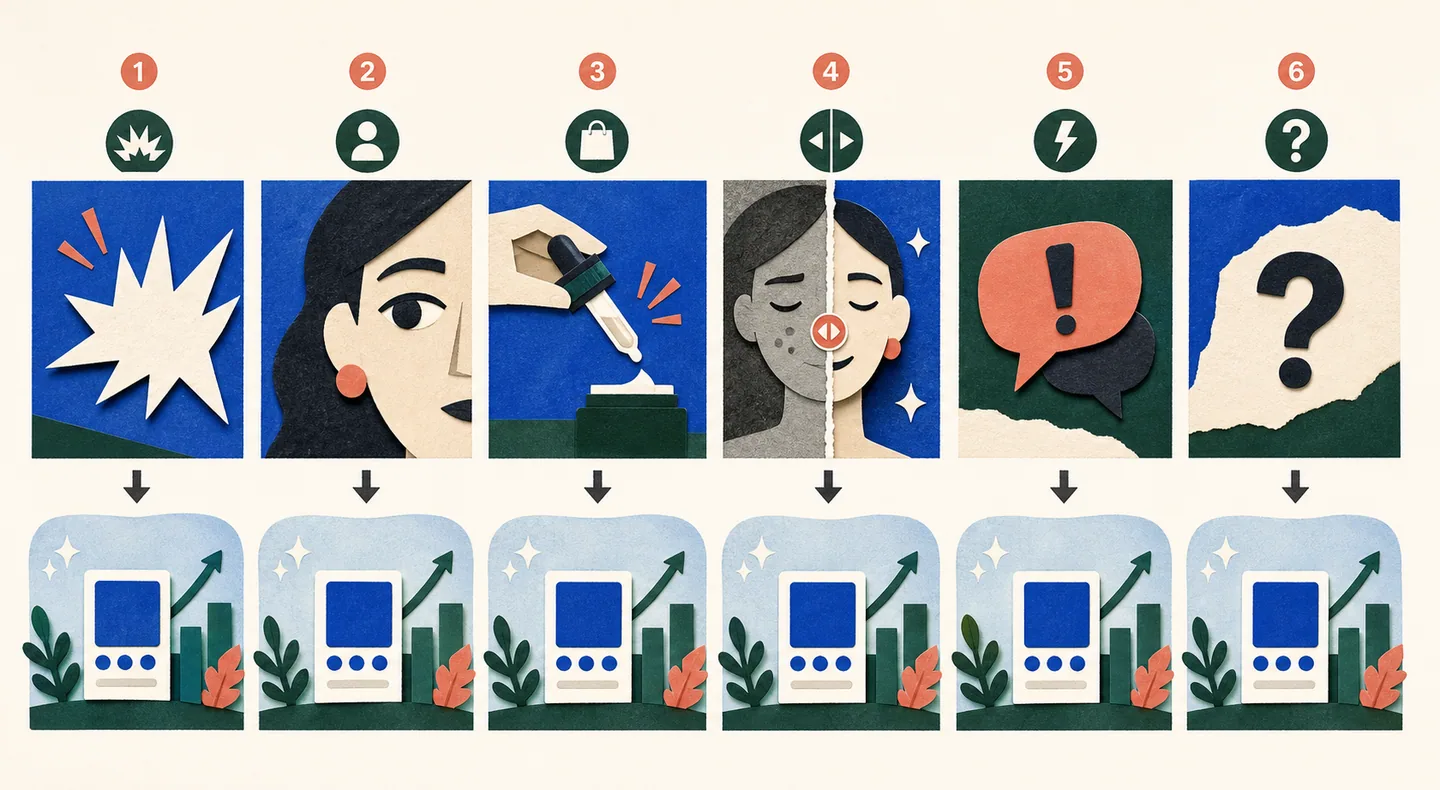
- Hook Style #1: The Bold Statement Opener
- Hook Style #2: The Face Close-Up
- Hook Style #3: Product-in-Action
- Hook Style #4: The Before/After Reveal
- Hook Style #5: The Controversy Opener
- Hook Performance by Product Category
- Thumbnail Psychology: The Science of Stopping Thumbs
- The Curiosity Gap Formula
- The Hook-to-Listing Pipeline: Where Most Sellers Fail
- The Decision Tree: Choosing Your Hook Style
- Testing Your Hooks: The Only Way to Know What Works
- The Bottom Line
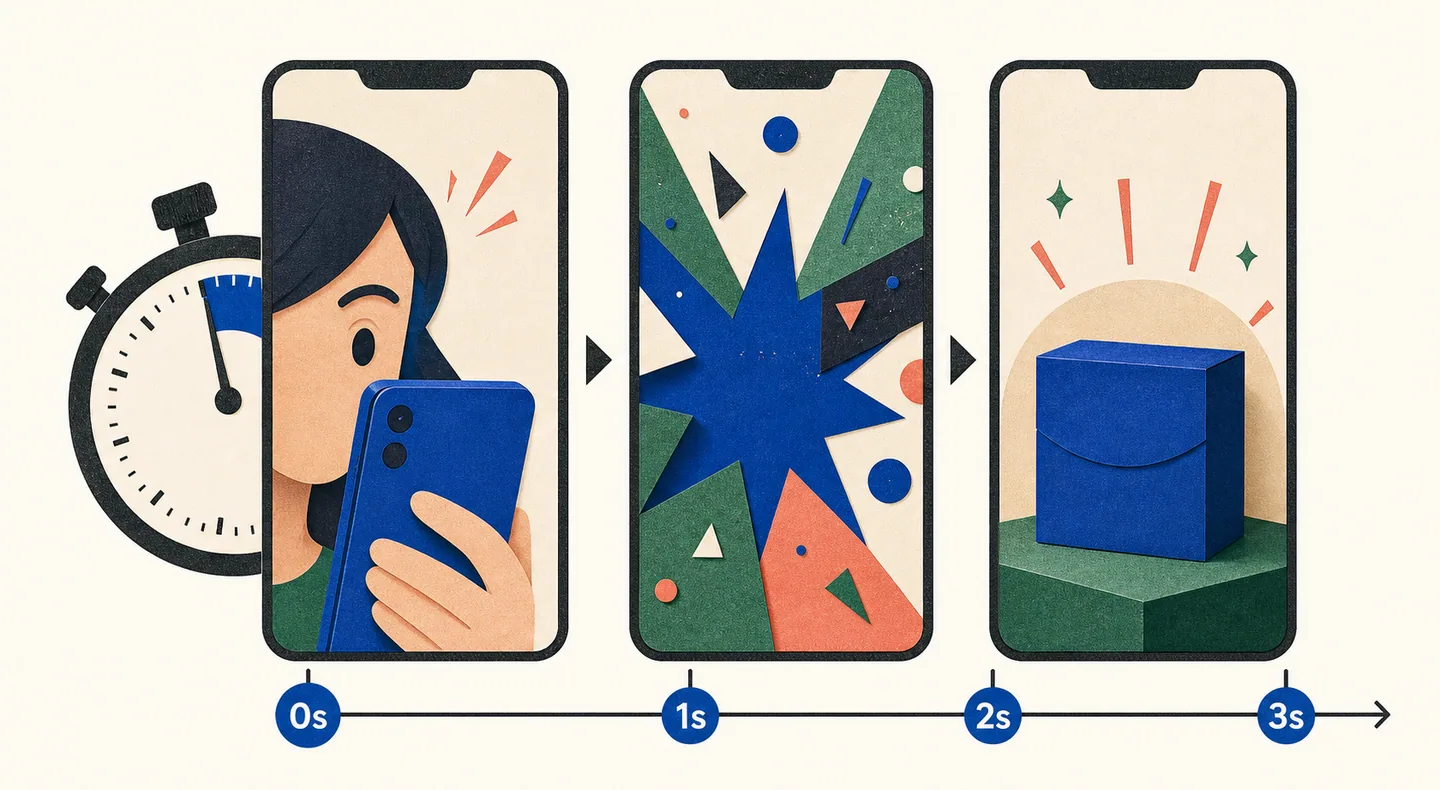
TikTok users decide whether to keep watching in roughly 0.4 seconds.
Not 3 seconds. Not 1 second. Four-tenths of a second. That’s how long you have before the thumb starts moving and your content disappears into the void.
By the 3-second mark, 33% of viewers have already scrolled past. If you haven’t stopped them by then, the algorithm has already decided your content isn’t worth pushing to a broader audience. Your video is dead—no matter how brilliant the rest of it might be.
This isn’t hyperbole. It’s the physics of attention on the fastest-moving content platform in history. TikTok’s recommendation algorithm prioritizes completion rate and watch time above all else. Videos with strong three-second retention rates (above 65%) receive 4 to 7 times more impressions than videos that lose viewers immediately.
The first three seconds aren’t just important. They’re everything.
The Anatomy of a Scroll-Stopping Hook
Before we break down specific hook styles, you need to understand the psychology that makes them work. Every effective TikTok hook exploits at least two of three psychological triggers:
Pattern interruption: Our brains are wired to notice anything that breaks the expected flow. When you’re scrolling through dozens of similar videos, something visually or verbally unexpected makes you pause.
Curiosity gaps: The space between what people know and what they want to know creates tension. Our brains hate unresolved questions. Fill the gap, and you earn attention.
Social proof: We pay attention when we see evidence that others have found something valuable. Results, transformations, and credibility signals stop thumbs.
The best hooks layer these triggers. A bold statement creates pattern interruption. A question opens a curiosity gap. Proof-first establishes social proof. Combine two or more, and you have a hook that doesn’t just stop the scroll—it demands attention.
Hook Style #1: The Bold Statement Opener
What it looks like:
Opening with a declarative sentence that challenges conventional wisdom or makes a surprising claim.
Why it works:
Bold statements create cognitive dissonance. The viewer’s brain registers the claim, compares it to existing beliefs, and pauses to evaluate credibility. That pause is your three-second hold.
Frame-by-frame breakdown:
- 0.0–0.5 seconds: Face fills 60% of frame, direct eye contact, neutral-to-serious expression
- 0.5–1.5 seconds: Text overlay appears: “Everything you know about [topic] is wrong”
- 1.5–3.0 seconds: Speaker delivers the bold claim verbally while maintaining eye contact
Best for: Educational content, contrarian insights, myth-busting, industry commentary
Category performance:
- Beauty: Strong (challenges common skincare mistakes)
- Electronics: Very strong (debunks tech misconceptions)
- Fashion: Moderate (works best for “what not to wear” angles)
- Food: Moderate (better for technique corrections than recipes)
The catch: Your video must deliver proof within 10–15 seconds. If you can’t back up the claim quickly, retention craters and trust evaporates.
Here’s where most sellers get stuck guessing: Upload 3–5 bold statement variations to Kettio and have synthetic TikTok shoppers score each one. You’ll see which claims create genuine curiosity versus which ones feel like empty clickbait. The written feedback tells you if your statement is specific enough to open a curiosity gap—or too vague to matter.
Hook Style #2: The Face Close-Up
What it looks like:
Extreme close-up of a human face—often showing emotion (surprise, concern, excitement) or a transformation in progress.
Why it works:
Research analyzing 300 TikTok thumbnails found videos featuring human faces significantly outperformed those without. A Georgia Tech study found images with faces received 38% more likes and 32% more comments. Faces create connection. Connection stops thumbs.
Frame-by-frame breakdown:
- 0.0–0.5 seconds: Face fills 70–80% of frame, emotional expression visible
- 0.5–1.5 seconds: Slight zoom or movement to create dynamism
- 1.5–3.0 seconds: Expression intensifies or transitions; text overlay appears with hook statement
Best for: Beauty transformations, emotional storytelling, personal testimonials, reaction content
Category performance:
- Beauty: Very strong (before/during application shots)
- Fashion: Strong (styling reactions, fit reveals)
- Electronics: Moderate (works for unboxing reactions)
- Food: Moderate (better for taste-test reactions than cooking)
The catch: The face must be authentic. Overly polished, commercial-style close-ups signal “advertisement” and trigger the scroll reflex.
There’s a shortcut most creators miss: Instead of guessing which facial expression and framing will resonate, test multiple face close-up variations in Kettio. Synthetic shoppers will tell you which feels authentic versus which looks “too salesy.” Feedback like “this feels like a friend recommending something” versus “this looks like an ad I’d skip” is the difference between a hook that converts and one that doesn’t.
Hook Style #3: Product-in-Action
What it looks like:
The product doing what it does best—solving a problem, creating a result, or demonstrating a feature in real-time.
Why it works:
Some things are better shown than explained. Product demos offer direct proof of value. Viewers can see exactly what the product does and imagine it working in their own lives.
Frame-by-frame breakdown:
- 0.0–0.5 seconds: Product in motion or mid-action (not static)
- 0.5–1.5 seconds: Result or transformation becomes visible
- 1.5–3.0 seconds: Text overlay with value proposition: “Watch this remove 5 years of grime in 30 seconds”
Best for: Home and kitchen gadgets, cleaning products, beauty tools, electronics with visible functionality
Category performance:
- Home/Kitchen: Very strong (#CleanTok content thrives on this)
- Beauty: Strong (tool demonstrations, application techniques)
- Electronics: Strong (feature demos, unboxing reveals)
- Fashion: Moderate (better for accessory demos than apparel)
The catch: The action must be visually satisfying. A product sitting on a counter doesn’t stop thumbs. A product transforming something does.
You can skip the trial-and-error: Test different product-in-action openings—slow reveal versus fast cut-in, different angles, different text overlays—against synthetic shoppers before you film the full video. Kettio shows you which visual approach creates the strongest “I need to see what happens” response. Film the winner. Skip the losers.
Hook Style #4: The Before/After Reveal
What it looks like:
Showing the transformation result first, then teasing how it was achieved.
Why it works:
Humans crave narrative completion. When you show the end result upfront, you create a curiosity gap that demands resolution. Viewers will watch to understand how you got there.
Frame-by-frame breakdown:
- 0.0–0.5 seconds: After state fills frame (clean surface, styled hair, organized space)
- 0.5–1.5 seconds: Quick flash or swipe to before state
- 1.5–3.0 seconds: Text overlay: “Want to know how we got here?”
Best for: Transformations of any kind—beauty, home organization, fitness, renovations, styling
Category performance:
- Beauty: Very strong (skincare results, makeup transformations)
- Home/Kitchen: Very strong (cleaning, organization reveals)
- Fashion: Strong (styling transformations, fit comparisons)
- Fitness: Strong (workout results, physique changes)
The catch: The transformation must be dramatic enough to create genuine curiosity. Subtle changes don’t open curiosity gaps—they close them.
The faster path to the right reveal: Upload different before/after sequencing options—result-first versus process-first, different transition speeds, different text framing—and see which one synthetic shoppers find most compelling. The feedback will tell you if your transformation is dramatic enough to drive curiosity or if you need a stronger visual contrast.
Hook Style #5: The Controversy Opener
What it looks like:
Opening with a polarizing opinion, hot take, or statement designed to spark immediate reaction.
Why it works:
Controversy triggers emotional engagement. Even viewers who disagree will often watch to see how you’ll defend your position—and many will comment to tell you why you’re wrong. Comments signal engagement to the algorithm.
Frame-by-frame breakdown:
- 0.0–0.5 seconds: Speaker with confident, slightly confrontational expression
- 0.5–1.5 seconds: Text overlay with the controversial statement
- 1.5–3.0 seconds: Speaker delivers the take verbally, maintaining strong eye contact
Best for: Industry commentary, opinion content, myth-busting, “unpopular opinion” formats
Category performance:
- Fashion: Strong (style rules to break, trend critiques)
- Beauty: Strong (product category takedowns, routine myths)
- Electronics: Moderate (brand comparisons, feature debates)
- Food: Moderate (technique controversies, ingredient opinions)
The catch: You must be ready to defend your position with facts. Empty controversy feels like clickbait and destroys trust. Substantiated controversy builds authority.
Test whether your take lands: Upload your controversy opener to Kettio and see if synthetic shoppers read it as substantive or empty clickbait. Feedback like “I want to hear more about this” versus “this feels like rage-bait” tells you whether your hot take will drive engagement or just drive people away.
Hook Performance by Product Category
Not all hooks work equally well across categories. Here’s what the data shows:
| Hook Style | Beauty | Home/Kitchen | Electronics | Fashion | Food |
|---|---|---|---|---|---|
| Bold Statement | Strong | Moderate | Very Strong | Moderate | Moderate |
| Face Close-Up | Very Strong | Moderate | Moderate | Strong | Moderate |
| Product-in-Action | Strong | Very Strong | Very Strong | Moderate | Strong |
| Before/After | Very Strong | Very Strong | Moderate | Strong | Moderate |
| Controversy | Strong | Low | Moderate | Strong | Moderate |
Key insight: Beauty and home/kitchen categories have the most hook versatility. Electronics relies heavily on product demonstration. Fashion performs best with face-driven and transformation content. Food is the most restrictive—product-in-action (cooking process) dominates.
Thumbnail Psychology: The Science of Stopping Thumbs
Your thumbnail is the first filter. Before anyone watches your video, they see a static frame. If that frame doesn’t stop the scroll, your hook never gets a chance to work.
Color Theory for TikTok Thumbnails
Color is the first thing people notice. Before reading text or recognizing faces, viewers make snap judgments based on visual impact.
High-contrast combinations that perform:
- Black/Yellow: Attention-grabbing, signals caution or importance
- White/Red: Urgency, excitement, stands out in dark-mode feeds
- Blue/Orange: Trust paired with energy, highly visible
Color psychology by category:
- Red: Urgency, excitement, intensity (good for limited-time offers, controversial takes)
- Blue: Trust, calm, professionalism (good for educational content, tech products)
- Yellow: Optimism, attention, happiness (good for positive transformations, food)
- Green: Growth, health, harmony (good for wellness, sustainability, money-saving)
- Orange: Energy, fun, affordability (good for casual products, deals)
Text Placement Rules
TikTok’s interface obscures significant screen real estate. Text in the wrong place disappears behind UI elements.
Safe zones:
- Position important text in the upper third of the screen
- Avoid the top and bottom 10% (obscured by notches and interface elements)
- Avoid the right third entirely (covered by engagement buttons)
- Center text horizontally for maximum visibility
Text best practices:
- Use bold sans-serif fonts (Impact, Montserrat Extra Bold, Anton)
- Keep text to 2–5 words maximum
- Add drop shadows or outlines for contrast
- Use ALL CAPS for emphasis
Face vs. No-Face: The Data
The research is clear: faces outperform.
- Videos with faces in thumbnails: +38% likes, +32% comments
- Close-up faces (60–80% of frame): Highest engagement
- Faces showing emotion: Better than neutral expressions
- Authentic, unpolished faces: Better than commercial-style photography
When to skip the face:
- Product demonstrations where the product itself is the hero
- Before/after reveals where the transformation is visual
- Certain electronics/gadget content where functionality matters most
The Curiosity Gap Formula
The most powerful psychological trigger in TikTok hooks is the curiosity gap—the space between what viewers know and what they want to know.
The formula:
Specific Promise + Withheld Information = Curiosity Gap
Examples that work:
- “I spent $300 on skincare before finding this $35 dupe” (specific numbers, withheld identity)
- “This one change doubled our conversion rate” (specific result, withheld method)
- “3 things you’re doing wrong with your morning routine” (specific number, withheld things)
Examples that don’t work:
- “You won’t believe this product!” (too vague, no specific promise)
- “Amazing transformation!” (no specifics, no curiosity gap)
- “Check this out!” (no promise, no gap)
The key is specificity. Vague promises don’t create curiosity gaps because there’s nothing specific to be curious about.
The Hook-to-Listing Pipeline: Where Most Sellers Fail
Here’s the critical insight most TikTok Shop sellers miss: your hook sets an expectation. Your product listing must deliver on it. For a deeper look at how this pipeline breaks down, see the five failure points killing TikTok Shop conversions.
The mismatch that kills sales:
Your video promises a transformation: “This serum faded my dark spots in 3 weeks.”
Your listing shows ingredient specs and no before/after photos.
The viewer clicked expecting validation of a specific promise. Instead, they found a generic product page. The disconnect kills conversion before it ever had a chance.
The alignment that drives sales:
Your video promises: “This serum faded my dark spots in 3 weeks.”
Your listing shows:
- Before/after photos with timeline
- Reviews mentioning the 3-week timeframe
- The specific feature highlighted in the video
This is “ad scent”—the continuity between what attracted the click and what greets the visitor. Break the scent, break the sale. Maintain the scent, and viewers flow naturally from interest to purchase.
Test your hook-to-listing alignment: Upload your video creative and product listing side by side in Kettio and have synthetic shoppers review them together. If the feedback says “the video made me expect before/after photos but the listing is just ingredient specs”—you found your leak without spending a cent on traffic. Fix it before you go live.
The Decision Tree: Choosing Your Hook Style
Not sure which hook to use? Follow this decision framework:
flowchart TD
    A["What are you selling?"] --> B{"Physical product?"}
    B -->|Yes| C{"Demonstrable result?"}
    B -->|No| D["Service/Content"]

    C -->|Yes| E{"Transformation visible?"}
    C -->|No| F["Bold Statement or Controversy"]

    E -->|Yes| G["Before/After Reveal"]
    E -->|No| H["Product-in-Action"]

    D --> I{"Personal expertise?"}
    I -->|Yes| J["Face Close-Up"]
    I -->|No| K["Bold Statement"]

    style A fill:#e1f5ff,color:#333,stroke:#e1f5ff
    style G fill:#d4edda,color:#333,stroke:#d4edda
    style H fill:#d4edda,color:#333,stroke:#d4edda
    style J fill:#d4edda,color:#333,stroke:#d4edda
    style F fill:#fff3cd,color:#333,stroke:#fff3cd
    style K fill:#fff3cd,color:#333,stroke:#fff3cd
Quick reference:
- Selling a physical product with visible results → Before/After Reveal
- Selling a physical product with functional benefits → Product-in-Action
- Selling expertise, coaching, or personal brand → Face Close-Up
- Making a contrarian claim or debunking myths → Bold Statement or Controversy
- No visible product or transformation → Bold Statement
Testing Your Hooks: The Only Way to Know What Works
All of this guidance is directional, not absolute. The only way to know which hook works for your specific audience and product is to test.
The testing framework:
- Create 3–5 hook variations for the same product/video
- Keep everything else identical—same product, same listing, same offer
- Run each variation to a small test audience (or use synthetic testing)
- Measure: Hook rate (2-second views / impressions), watch time, click-through rate
- Double down on the winner, iterate on the losers
What to test:
- Hook style (bold statement vs. face close-up vs. product-in-action)
- Opening text overlay (different curiosity gaps)
- Color schemes and visual framing
- Pacing (fast cut-in vs. slow reveal)
The faster way through this: Running live traffic through hook variations takes weeks and burns budget on underperforming variants. In Kettio, you can test 3–5 hook variations synthetically—all in one session. Upload your hook candidates, define your target demographic (Gen Z women who shop beauty on TikTok, budget-conscious moms, etc.), and get scores plus written feedback from 1,000 AI consumers who think like your buyers. Learn more about how synthetic audience panels work and why they predict real performance. You can run through the full decision tree in an afternoon instead of over weeks of expensive trial and error. Here’s a creative testing workflow to structure the process.
The Bottom Line
The first three seconds of your TikTok content determine whether the next thirty seconds ever get watched. They determine whether the algorithm pushes your content to thousands or buries it at 200 views.
Master the hook styles. Understand the psychology. Test relentlessly.
The creators who treat those first three seconds as sacred are the ones building audiences, driving sales, and turning TikTok into a real business channel.
Everyone else is just hoping for luck.
🏪 Connect Your TikTok Shop
Great hooks drive traffic. Kettio’s TikTok Shop tool makes sure your listings convert that traffic into sales—audit your titles, images, and descriptions automatically.
Stop guessing which hook will stop the scroll. Test your TikTok hooks against synthetic shoppers who think like your buyers—before your next dollar goes to waste.
Try it on your ads
Compare your own ads, free.
Upload two static ads, choose your buyer, and get a quick prediction with clear next steps. No signup or credit card.
Find my winning ad →