
On this page8 sections
- The five jobs inside a Meta creative testing workflow
- 1. Meta Ads Manager: best source of final behavioral truth
- 2. Motion: best for understanding creative after launch
- 3. Foreplay: best for inspiration, organization, and briefs
- 4. Marpipe: best for structured multivariate testing
- 5. Kettio: best for blind back-testing and pre-launch ranking
- Recommended stacks by team type
- How to choose without buying another shelfware tool
The phrase “creative testing tool” now covers several completely different products. Some tools organize inspiration. Some generate variations. Some analyze ads after spend. Others help decide what should receive spend in the first place.
The best tool depends on where your team is losing time or money. Buying a creative library when the real problem is post-launch reporting will not fix the workflow. Neither will adding a reporting dashboard when the bottleneck is choosing 20 ads from a batch of 200.
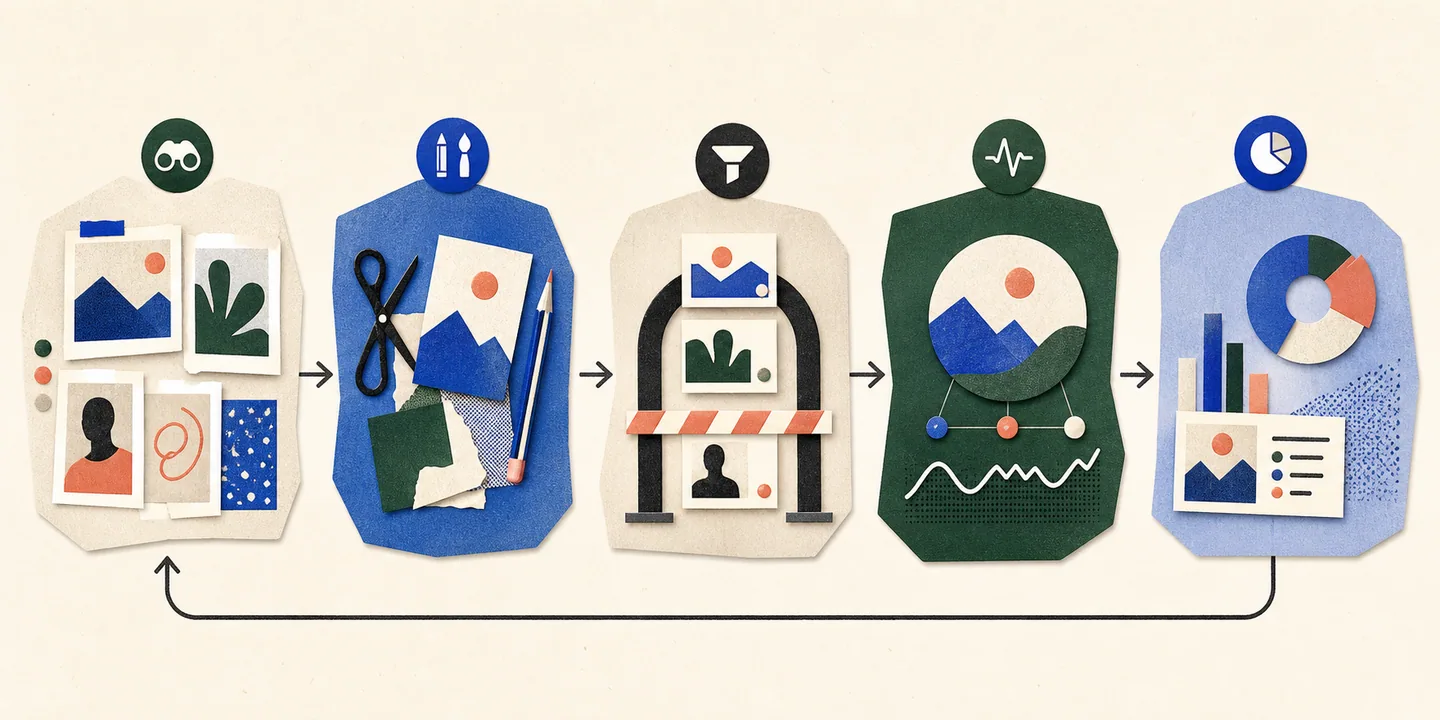
The five jobs inside a Meta creative testing workflow
- Research: find patterns, competitor ads, hooks, and references
- Production: create enough distinct concepts and variations
- Pre-launch selection: decide what deserves initial spend
- Live experimentation: let Meta collect behavioral evidence
- Post-launch analysis: explain what won and feed the lesson back into production
Serious performance teams usually need more than one tool because no product is best at all five jobs.
| Tool | Best for | Workflow position | Main limitation |
|---|---|---|---|
| Meta Ads Manager | Behavioral truth and controlled live tests | Live experimentation | Requires spend and delivery |
| Motion | Creative analytics and reporting | Post-launch analysis | Needs campaign performance data |
| Foreplay | Swipe files, research, and briefing | Research and planning | Does not prove which new ad will win |
| Marpipe | Systematic multivariate creative tests | Production and experimentation | Best when assets follow a structured variable system |
| Kettio | Blind back-tests and pre-launch batch ranking | Pre-launch selection | Directional signal; Meta remains final proof |
1. Meta Ads Manager: best source of final behavioral truth
Meta Ads Manager is where creative ultimately proves itself. The auction considers the campaign objective, audience, budget, duration, and creative, then delivery learns who is most likely to respond.
Meta is the right tool when you need observed purchases, leads, clicks, or another real campaign outcome. It also supports A/B testing and recommends creative diversification so the system has meaningfully different messages to match with people.
Know which ad to scale before you spend.
Upload two static ads, choose your buyer, and get a quick prediction with clear next steps. No signup or credit card.
The limitation is built into the model: live learning requires delivery. If your team produces far more creative than it can responsibly fund, Ads Manager cannot eliminate the initial selection problem. Read Meta’s official overview of how the ad auction works.
2. Motion: best for understanding creative after launch
Motion is built for teams that already have meaningful paid-social data and need to understand performance by ad, concept, hook, format, or other creative dimension. It helps strategists and media buyers turn campaign results into clearer creative reporting.
Choose Motion when the painful question is: “Why did this ad win, and what should we make next?”
Motion sits downstream from launch. It is not primarily a blind pre-launch prediction system, and it needs performance data before its strongest analysis becomes possible.
3. Foreplay: best for inspiration, organization, and briefs
Foreplay is a research and creative-strategy workspace. Teams use it to save competitor ads, organize references, monitor brands, and translate inspiration into briefs.
Choose Foreplay when research is scattered across bookmarks, Slack messages, and screenshots. It is especially useful for agencies that need a shared visual vocabulary across strategists, designers, and clients. If you like the swipe-file workflow but need performance data on top of it, we compared the five strongest Foreplay alternatives on exactly that gap.
Foreplay answers “what is running in the market?” and “what should we study?” It does not independently establish which new creative will produce the best outcome. See our deeper Foreplay alternatives comparison.
4. Marpipe: best for structured multivariate testing
Marpipe is strongest when a team wants to test creative variables systematically. Instead of treating every ad as an unrelated object, a multivariate workflow can compare combinations of headlines, product shots, layouts, and other elements.
Choose Marpipe when your production system can supply modular creative components and your goal is to learn which variables contribute to performance.
The tradeoff is structure. Multivariate systems work best when the creative has been designed for recombination. They are less natural for a messy archive of one-off concepts from several brands or agencies.
5. Kettio: best for blind back-testing and pre-launch ranking
Kettio sits between production and media. A team submits a batch, defines the buyer and conversion goal, and receives a relative ranking, shortlist, rationale, and confidence signal before launch.
The most credible starting point is not a polished demo. It is a blind back-test against the team’s historical outcomes. Kettio ranks the ads without seeing purchases, CPA, ROAS, CTR, or winner labels. The team then reveals the data and measures whether the real winners were contained in the shortlist.
Choose Kettio when production volume is higher than the amount of creative your media team can responsibly test. Kettio does not replace Meta’s behavioral evidence. Its job is to improve the group that reaches Meta.
Recommended stacks by team type
Small DTC team
Use Meta Ads Manager for live truth, a simple reference library for research, and a lightweight pre-launch prediction for the most expensive decisions. Start by finding your winning ad.
High-spend in-house performance team
Use Foreplay or an equivalent library for research, Kettio for pre-launch batch selection, Meta for live validation, and Motion for post-launch analysis. The stack creates a closed loop: research, rank, launch, learn.
Performance agency
Prioritize repeatability across accounts. Use a shared research and briefing system, a pre-launch ranking layer that preserves client and campaign context, Meta for final proof, and a reporting system that can compare creative patterns across brands.
How to choose without buying another shelfware tool
Pick one campaign and name the broken handoff. Is research failing to reach the brief? Are too many ads entering live tests? Is the team unable to explain winners? Then evaluate the tool against that one handoff.
For pre-launch selection, do not evaluate a platform only on its sample scores. Give it old creative, hide the results, and see whether it finds your real winners. If you have 50 or more historical assets, apply for a blind Kettio back-test.
Frequently asked questions
What is the best Meta creative testing tool?
Meta Ads Manager is the final source of behavioral truth. Motion is strongest for post-launch analysis, Foreplay for research and briefs, Marpipe for structured multivariate testing, and Kettio for blind back-tests and pre-launch batch ranking.
Does Foreplay test ad performance?
Foreplay is primarily a creative research, swipe-file, and briefing workspace. It helps teams study what is running and organize creative strategy, but live or historical performance validation requires another layer.
Can creative testing tools replace Meta A/B tests?
No. Pre-launch tools can prioritize a stronger shortlist, while Meta provides final behavioral evidence through real delivery. The two stages solve different decisions.
What tool should a high-spend DTC team use?
A high-spend DTC team commonly needs a research library, a pre-launch ranking layer, Meta for live validation, and a post-launch analytics tool. The right combination depends on which workflow handoff is currently failing.
Compare your own ad creatives — free.
Upload two static ads, choose your buyer, and get a quick prediction with clear next steps. No signup or credit card.
Find my winning ad →