
On this page12 sections
- Part 1: Generating AI Ad Creatives
- Start With a Tight Brief, Not an Open Prompt
- Generate More Variants Than You Think You Need
- What the Built-in Scores Don’t Tell You
- Part 2: Testing AI Ad Creatives Before You Spend
- The Old Way: Spend to Learn
- The New Way: Test Before You Launch
- What the Research Shows
- Part 3: Launching the Winner
- Use the Rationale to Sharpen the Winner
- Set Up the Campaign for Post-Launch Learning
- The Full Stack
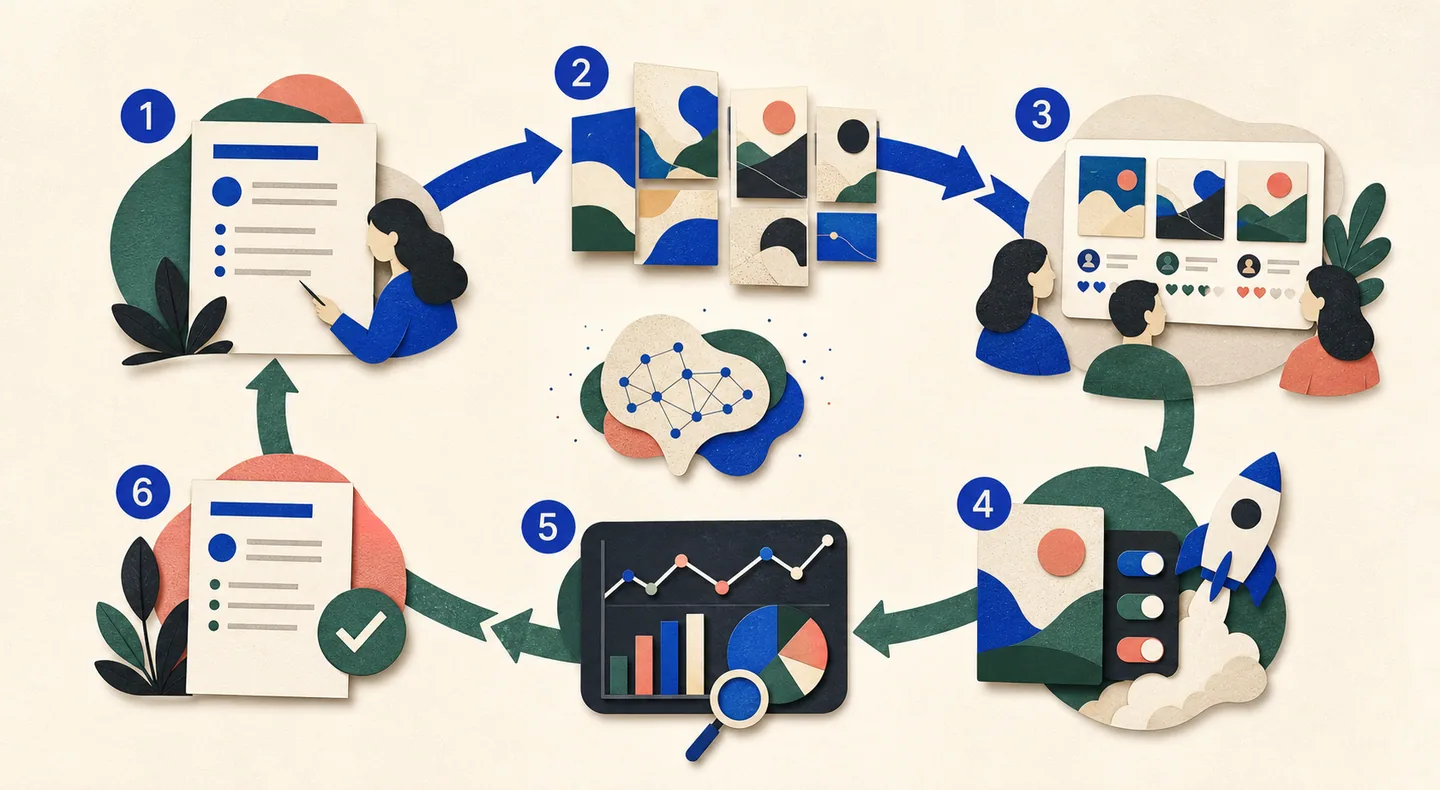
AI creative tools have crossed the threshold where you can generate 10 solid variants in the time it used to take to brief a designer on one. But generating fast is only half the job. The workflow most teams are running, generate, pick a few, launch, see what happens, leaves the most valuable step out entirely. This guide covers the full picture: how to generate AI generated ad creatives that are worth testing, how to test them before you spend, and how to launch the actual winner instead of guessing.
Part 1: Generating AI Ad Creatives
The AI ad creative generator market has matured fast. Tools like AdCreative.ai, Canva AI, and InVideo can produce credible creative variants at scale. The generation step is no longer the bottleneck. What follows is how to use these tools effectively. (One input generators consistently get wrong: copy length — our study of 261 long-running Meta ads found category norms varying 29×, so tell your generator what vertical you’re in.)
Start With a Tight Brief, Not an Open Prompt
The quality of your generated creatives is directly proportional to the specificity of your input. Vague prompts produce generic output. Before you open any generator, nail down four things: the single benefit you’re communicating, the emotional state of your target buyer at the moment they’d see this ad, the platform and placement, and the desired action.
A brief like “ad for a skincare brand” produces templates. A brief like “static image ad for a $48 vitamin C serum targeting 28-34-year-old women on Instagram Stories who are already buying skincare but skeptical of premium claims, goal is first purchase” produces candidates worth testing.
Generate More Variants Than You Think You Need
The value of AI generated ad creative tools is that marginal generation cost is essentially zero. Generate 15 to 20 variants. Not 3. You’re going to test them before you launch, so having more candidates gives you more signal. The goal at this stage is coverage: explore the space of possible approaches (price-led, benefit-led, social proof, urgency, visual-first) before you converge.
What the Built-in Scores Don’t Tell You
Most AI ad creative generator platforms include some kind of predictive score. AdCreative.ai has its Creative Score. These scores are pattern-matched against historical high-performing ads. They are useful for filtering out obviously weak candidates. They are not a substitute for audience testing.
A score trained on aggregate ad performance data tells you whether your creative looks like past winners in general. It tells you nothing about whether it will win with your specific audience, on your specific platform, for your specific offer. For that, you need to actually test against your audience. That’s what Part 2 covers.
Part 2: Testing AI Ad Creatives Before You Spend
The expensive part of paid social isn’t making ads — it’s running the wrong ones. Launching multiple variants and letting performance data pick the winner burns real media budget on every losing creative during the test window, and that budget doesn’t come back.
The Old Way: Spend to Learn
Facebook’s A/B testing tool is the default testing infrastructure for most teams. You split your budget across variants, wait for statistical significance (typically 2 to 4 weeks at meaningful spend levels), then kill the losers. This works. It’s also expensive: you’re paying for the learning itself, and the information arrives after the fact.
The New Way: Test Before You Launch
Kettio’s ad testing platform flips this workflow. Instead of launching to find out which creative wins, you test your variants against synthetic personas built to represent your target buyer before you spend a dollar on media.
The process for ad creative testing works like this:
Upload your variants, the ones you generated in AdCreative.ai, Canva, InVideo, or anywhere else. Define your target audience: the demographics, the shopping context, the platform they’re on, how skeptical they are, how price-sensitive they are. Kettio builds synthetic personas matching that profile and runs your creatives through them.
The output isn’t a number. It’s a ranked list with written rationales. You’ll see something like: “Your 28-year-old skeptical browser paused on creative B because the visual created urgency, but scrolled past creative A because the price signal felt premium for a first-purchase context.” That kind of specific, audience-grounded feedback is what you need to make a launch decision with confidence.
What the Research Shows
Kettio’s predictions are grounded in published benchmarks, not marketing copy. The short version: 58% pairwise accuracy on a 1,089-image academic dataset, beating GPT-4o zero-shot. The full methodology and results are in our benchmark writeup. That’s a meaningful edge over launching blind, especially at scale.

Part 3: Launching the Winner
Once you’ve tested your variants and have a ranked order with rationales, the launch decision becomes straightforward. You’re not guessing between creatives that all looked fine in the internal review. You’re launching the one that your target audience actually responds to.
Use the Rationale to Sharpen the Winner
The written feedback from your testing isn’t just a selection tool. It’s a creative brief for improvement. If the top-ranked creative scored well on visual attention but the rationale flags weak copy, you know exactly what to iterate on before launch. If the second-ranked creative is losing on price signaling but winning on brand trust, you can think about whether a different offer structure would change the outcome.
Set Up the Campaign for Post-Launch Learning
Pre-launch testing reduces the cost of learning but doesn’t eliminate it. Once you launch the predicted winner, use Meta’s campaign structure (or your platform’s equivalent) to track performance at the creative level. When you have real data, feed it back into your next generation cycle: use what actually worked to brief better variants next time.
The Full Stack
The three-stage cycle in this guide, generate more than you need, test before any spend, launch the winner, is the workflow that makes AI creative generation actually pay off. We wrote the detailed step-by-step with tool recommendations for each stage in the complete generate–test–launch workflow.
For a tool-by-tool breakdown of what’s worth using at each stage, see our roundup of the best AI ad tools in 2026. For an honest look at AdCreative.ai specifically, see our AdCreative.ai review. If you’re running A/B tests with real spend and want to understand the alternative, read why pre-launch testing is replacing A/B tests.
The complete workflow is generate, test, launch. Most teams have the first and third. The testing layer is where the difference compounds over time. For the tool-by-tool breakdown of what’s worth using at each stage, the AI ad tools roundup has the full picture.
Try it on your ads
Compare your own ads, free.
Upload two static ads, choose your buyer, and get a quick prediction with clear next steps. No signup or credit card.
Find my winning ad →