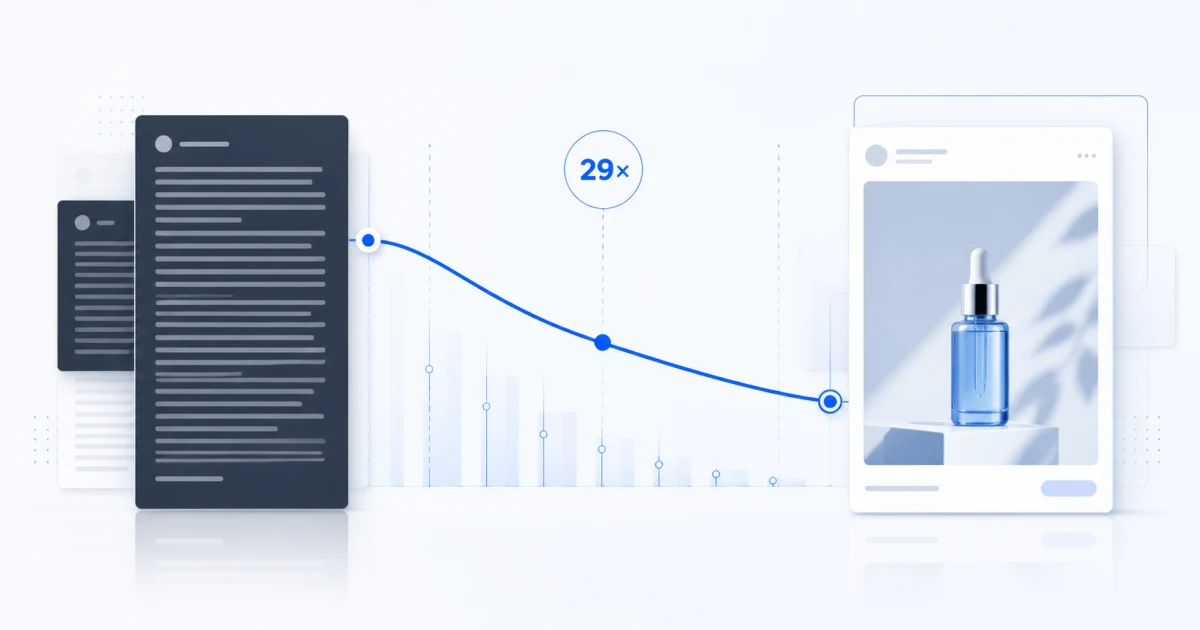
“How long should ad copy be?” Every answer you’ll find is a universal rule: keep it short, nobody reads anymore — or go long, story sells. So we stopped asking gurus and asked the survivors instead: 261 Meta ads that have each been running continuously for five months or more, measured character by character. The honest answer is that the question is unanswerable without naming the category first — among survivors, median copy length varies 29× between categories. Same platform, same month, same image format.
What we measured
In August 2026 we sampled the Meta Ad Library for US image ads that were still ACTIVE after at least 5 months of delivery. Ad platforms retire losers quickly, so an ad that has been running continuously for half a year is a survivor — the advertiser has kept paying for it because it keeps working. Copy length among survivors tells you what each category’s buyers actually tolerate, with the losers already filtered out by the market.
After cleaning, the corpus is 261 ads from roughly 160 distinct advertisers across 9 categories. To keep any single advertiser or advertorial operation from skewing a category: max 3 ads per advertiser page, near-duplicate ad bodies capped at 2, off-topic ads removed with per-category keyword filters, and two categories dropped entirely for contamination or emptiness (more on those below — they turned out to be findings in their own right). Median ad age ranged from 181 to 253 days by category. Full methodology at the end.
Losers get retired in weeks. Every ad in this dataset has been paid to keep running for at least five months straight.
The result: a 29× canyon
| Category | Clean n | Median chars | Median words | Advertorial share (>2,000 chars) | Under 200 chars |
|---|---|---|---|---|---|
| Supplements | 26 | 9,288 | 1,556 | 88% | 0% |
| Pet products | 18 | 9,187 | 1,556 | 83% | 0% |
| Fitness* | 9 | 6,128 | 1,055 | 56% | 0% |
| Mattress & home | 13 | 2,248 | 333 | 62% | 0% |
| Skincare | 15 | 1,723 | 321 | 40% | 0% |
| Food & beverage* | 9 | 1,723 | 321 | 33% | 11% |
| Shoes | 51 | 552 | 81 | 14% | 6% |
| Apparel | 55 | 394 | 54 | 22% | 13% |
| Jewelry | 65 | 321 | 41 | 12% | 34% |
Two different games are being played
The distribution isn’t a smooth gradient — it’s two clusters with a thin middle. Put the two median survivors side by side and you can see the whole finding at a glance:
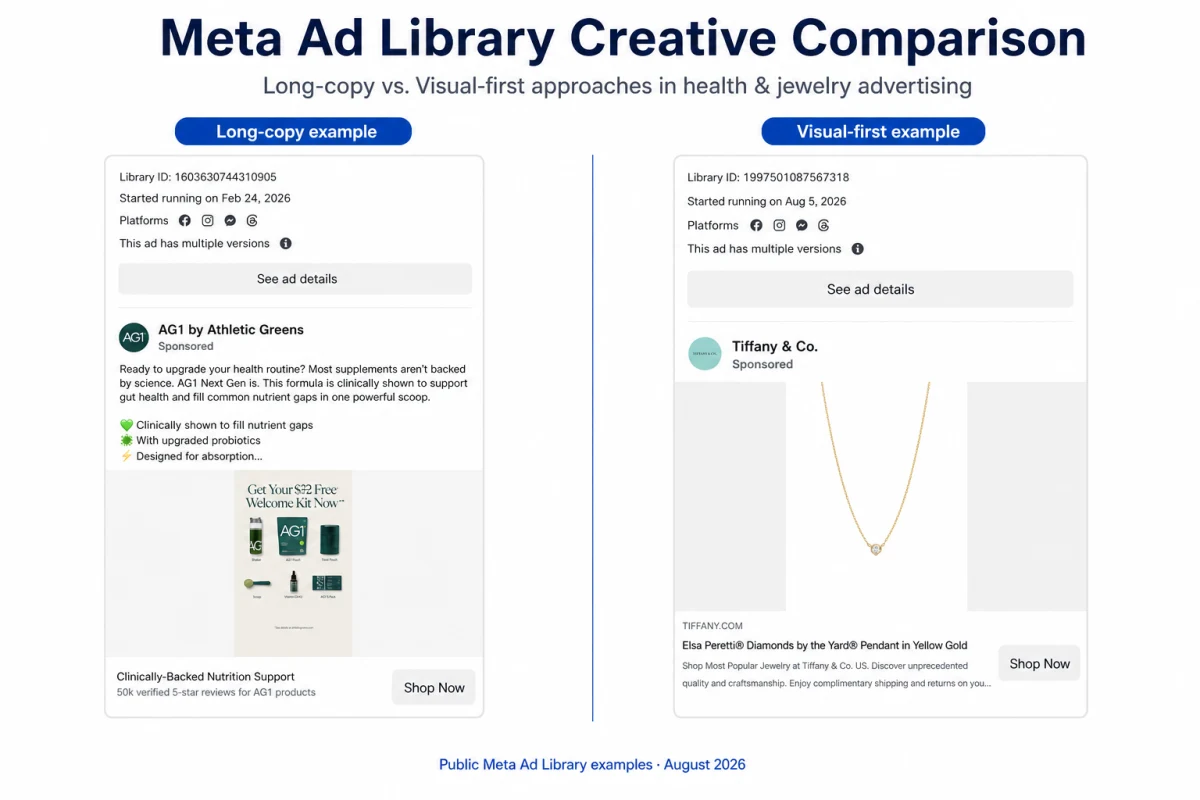
Evidentiary categories (supplements, pet products, fitness) sell claims the buyer is trained to distrust: this will fix your gut, calm your dog, change your body. Among their long-running survivors, 83–88% are full advertorials — 2,000+ characters of first-person story, objection handling, and mechanism explanation. The median supplement survivor carries 1,556 words of copy. That is not a landing page. That is the ad.
Visual categories (shoes, apparel, jewelry) sell things the buyer can evaluate with their eyes. The image does the persuasion; copy is a caption. Median jewelry survivor: 41 words. A third of jewelry survivors run under 200 characters — product name, a benefit, a link. Long copy doesn’t survive here, plausibly because it adds friction to a decision the photo already closed. Nobody reads 1,556 words about a ring; the survivors say plenty of people will read 1,556 words about their gut.
The middle (skincare, mattress & home, food) is genuinely bimodal rather than mid-length: skincare’s median is 1,723 characters but its 75th percentile is 3,871, and mattress & home jumps from 1,100 at p25 to 8,543 at p75. These categories sustain both playbooks at once — visual product ads and heavy advertorials — often for the same kind of product sold on different psychology.
The dogs that didn’t bark: B2B and mobile games
Two planned categories produced almost nothing — and both absences turned out to be findings.
B2B software: zero. Twelve search terms — CRM, payroll, invoicing, help desk, and more — returned not a single US image ad that had run continuously for 5+ months. B2B advertisers on Meta appear to rotate creative fast and lean on other formats; the long-lived static workhorse ad is a consumer phenomenon.
Mobile games: effectively zero. The handful of hits our game-related searches returned turned out to be misindexed jewelry ads, and we dropped the category. Game advertisers are famous for extreme creative churn and video-first buying, and the survivor archive backs that up: almost nothing static from this category lives long enough to qualify.
What this means for your ads
- Ignore universal copy-length advice. “Shorter is better” and “long copy sells” are both right — in different categories. Any benchmark that doesn’t name a category is noise.
- Find your category’s friction level. Selling something ingestible, health-adjacent, or claim-heavy? The survivors say buyers expect to be argued with — evidence, story, objection handling. Selling something the eye can judge? The survivors say get out of the picture’s way.
- A quick self-test: pull 20 long-running ads from your category in the Ad Library. If most run past 2,000 characters, you’re in an evidentiary category and a 40-word ad is probably underselling. If most run under 500, your 1,000-word story ad is likely fighting the format.
- Test against your own buyer, not a global average. Copy norms are category-conditioned because buying psychology is. That’s also why we built our own creative flow testing to judge creatives against a specific audience rather than an all-ads average — you can score two of your ads free and see which one your buyer actually moves on.
Methodology & limitations
Source: Meta Ad Library API, queried August 2026. Inclusion: US-reachable image ads, status ACTIVE, with a delivery start date at least 5 months prior (all sampled ads started before mid-March 2026). Copy length = ad body + headline + link description + caption, in characters and words. Sampling: 4–12 search terms per category, paginated until exhaustion or 120 ads. Cleaning: max 3 ads per advertiser page; near-identical ad bodies capped at 2 occurrences; per-category topic filters (an ad in the jewelry sample must actually be about jewelry); pages posing as authors/publications excluded; one cross-category advertorial operation (smoking-cessation stories running under shopping-page names) removed wherever it appeared.
Limitations, honestly: survivorship is a proxy for effectiveness, not proof — an ad can run long for reasons other than performance. Keyword search doesn’t see ads whose copy avoids category words. Fitness and food & beverage cleared cleaning with only 9 ads each and should be read as directional. And this measures written copy, not text rendered inside the image. The raw category summaries are available on request.
If you want the same style of pre-launch judgment on your own creatives — ranked against your actual buyer, not a cross-category average — our Facebook A/B testing guide covers the workflow, and the Meta testing tools comparison shows where each tool fits.
Frequently asked questions
How long should Facebook ad copy be?
It depends almost entirely on your category. Among Meta ads that survived 5+ months of continuous delivery in August 2026, median copy length was 9,288 characters for supplements, about 1,700 for skincare and food, and just 321 for jewelry — a 29× spread. Claim-heavy (evidentiary) categories reward long advertorial copy; visually-judged categories reward short captions.
What is an advertorial ad?
An ad written as a first-person story or editorial article — typically 2,000+ characters of narrative, objection handling, and product explanation — rather than a short caption. In this study, 83–88% of long-running supplement and pet-product ads were advertorials, versus 12–22% in shoes, apparel, and jewelry.
Why do supplement ads have such long copy?
Supplements sell claims buyers are trained to distrust, so surviving ads carry the evidence load in the ad itself: personal stories, mechanisms, and objection handling. The median long-running supplement ad in this study ran 1,556 words. Visual products like jewelry face little skepticism the photo cannot resolve, so their surviving ads stay short.
How was this study conducted?
We queried the Meta Ad Library API in August 2026 for US image ads still active after 5+ months of delivery — a survivorship filter, since platforms and advertisers retire underperforming ads quickly. After deduplication, per-advertiser caps, and topic cleaning, the corpus was 261 ads from about 160 advertisers across 9 categories.
Try it on your ads
Compare your own ads, free.
Upload two static ads, choose your buyer, and get a quick prediction with clear next steps. No signup or credit card.
Find my winning ad →