
Most TikTok Shop sellers treat listing optimization like guesswork.
They write a title that “sounds good.” They upload images that look professional. They write a description that covers the basics. Then they wonder why their listings languish on page three of search results while competitors with inferior products dominate the top spots.
Here’s what they miss: TikTok Shop’s algorithm is systematic. It evaluates listings against specific criteria. It rewards certain patterns and penalizes others. The sellers winning on this platform aren’t guessing—they’re following a playbook that aligns with how the algorithm actually works.
This is that playbook.
How TikTok Shop Search and Discovery Actually Works
Before you can optimize for TikTok Shop’s algorithm, you need to understand what it’s optimizing for. Unlike Amazon’s search-heavy model, TikTok Shop operates on a hybrid system that blends search signals with engagement patterns.
flowchart TD
    A["Product Listing Created"] --> B["Algorithm Indexes Title & Description"]
    B --> C["Visual Search Analyzes Images"]
    C --> D{"Initial Ranking"}
    D --> E["Shown to Test Audience"]
    E --> F{"Engagement Signals"}
    F -->|"High CTR + Watch Time"| G["Boosted in Search & FYP"]
    F -->|"Low Engagement"| H["Deprioritized"]
    G --> I["More Traffic → More Data"]
    I --> J["Algorithm Refines Ranking"]

    style A fill:#e1f5ff,color:#333,stroke:#e1f5ff
    style G fill:#d4edda,color:#333,stroke:#d4edda
    style H fill:#ff6b6b,color:#fff,stroke:#ff6b6b
The three signal categories:
1. Content Signals (What you put in your listing):
- Title keywords and structure
- Description length, keywords, and formatting
- Image quality, quantity, and relevance
- Video presence and engagement
- Product attributes and category alignment
2. Engagement Signals (How users interact):
- Click-through rate from search/browse
- Watch time on product videos
- Add-to-cart rate
- Conversion rate
- Review velocity and sentiment
3. Trust Signals (Algorithm confidence):
- Seller response rate to reviews
- Order fulfillment speed
- Return rate
- Customer service metrics
- Account standing and violations
The key insight: TikTok’s algorithm prioritizes listings that convert. A listing with perfect keywords but low engagement will sink. A listing with decent keywords and high engagement will rise. Your optimization goal isn’t just to be found—it’s to convert the visitors who find you. For a deeper look at where conversions break down, see the five failure points killing TikTok Shop conversions.
The Title Formula That Ranks and Converts
Your title is the first thing the algorithm indexes and the first thing shoppers see. It needs to do two jobs simultaneously: rank for relevant searches and compel clicks.
The proven formula:
[Primary Keyword] + [Benefit] + [Differentiator] + [Size/Variant]
Character limits:
- TikTok truncates titles around 80 characters
- Aim for 40–80 characters total
- Front-load your most important keywords
10+ Real Examples by Category:
| Category | Formula Applied | Result |
|---|---|---|
| Beauty | [Vitamin C Serum] + [Dark Spot Corrector] + [With Hyaluronic Acid] + [30ml] | “Vitamin C Serum Dark Spot Corrector With Hyaluronic Acid 30ml” |
| Beauty | [Waterproof Mascara] + [24-Hour Volume] + [Vegan Formula] + [Black] | “Waterproof Mascara 24-Hour Volume Vegan Formula Black” |
| Fashion | [High-Waisted Yoga Pants] + [Tummy Control] + [Pocket Design] + [Medium] | “High-Waisted Yoga Pants Tummy Control Pocket Design Medium” |
| Fashion | [Oversized Hoodie] + [Cozy Fleece Lining] + [Unisex] + [Large] | “Oversized Hoodie Cozy Fleece Lining Unisex Large” |
| Electronics | [Wireless Earbuds] + [48-Hour Battery] + [Noise Cancelling] + [White] | “Wireless Earbuds 48-Hour Battery Noise Cancelling White” |
| Electronics | [Phone Charger] + [Fast Charge 20W] + [MFi Certified] + [6ft Cable] | “Phone Charger Fast Charge 20W MFi Certified 6ft Cable” |
| Home | [Bamboo Cutting Board] + [Non-Slip Feet] + [Juice Groove] + [Large] | “Bamboo Cutting Board Non-Slip Feet Juice Groove Large” |
| Home | [LED Desk Lamp] + [Eye-Caring Light] + [USB Charging Port] + [Black] | “LED Desk Lamp Eye-Caring Light USB Charging Port Black” |
| Food | [Protein Powder] + [25g Per Serving] + [Chocolate Flavor] + [2lb] | “Protein Powder 25g Per Serving Chocolate Flavor 2lb” |
| Fitness | [Resistance Bands] + [Full Body Workout] + [5 Resistance Levels] + [Set of 5] | “Resistance Bands Full Body Workout 5 Resistance Levels Set of 5” |
What to avoid in titles:
- Promotional language: “50% OFF!” or “HOT ITEM!” (TikTok downgrades these)
- Emoji spam: (algorithm penalty)
- All caps: “AMAZING PRODUCT” (reads as spam)
- Vague descriptors: “Best Seller” or “High Quality” (no search value)
- Seller info: Your store name, contact details, URLs
Here’s where most sellers waste weeks guessing: Test 3–5 title variations in Kettio before you commit. Upload your candidates with different keyword orders, benefit statements, and differentiators. Synthetic shoppers will tell you which titles create the strongest “I need to click this” response—and which ones feel generic or spammy.

The Description Structure That Converts
Your description has one job: turn interest into action. It needs to validate the promise made in your title and video, provide the details shoppers need to decide, and remove any remaining hesitation.
The proven structure:
Hook Line → Key Features → Social Proof → Shipping Info → CTA
TikTok’s requirements:
- Minimum 500 characters
- Maximum 4,000 characters
- Use line breaks and formatting for readability
- Include relevant keywords naturally
The Template:
[HOOK LINE — 1–2 sentences]
Start with a benefit-driven statement that matches your video promise. This is your elevator pitch.
Example: “The viral dark spot serum that dermatologists swear by—now with over 50,000 verified reviews from real customers who’ve seen real results.”
[KEY FEATURES — 3–5 bullet points]
Translate features into benefits. Don’t just say what it is—say why it matters.
- 15% vitamin C with ferulic acid for maximum absorption and visible brightening in as little as 3 weeks
- Hyaluronic acid base hydrates while it treats—no dryness, no irritation, no downtime
- Fragrance-free, cruelty-free formula developed with board-certified dermatologists
- Lightweight texture absorbs instantly—no sticky residue, works under makeup
- Suitable for all skin types including sensitive skin
[SOCIAL PROOF — 1–2 sentences]
Reinforce trust with specific numbers or endorsements.
Example: “★★★★★ 4.8/5 from 52,000+ reviews. Featured in Allure, Cosmopolitan, and Byrdie as a top vitamin C serum under $30.”
[SHIPPING INFO — 1 sentence]
Remove final hesitation with clear delivery expectations.
Example: “Ships within 24 hours from our US warehouse. Free shipping on orders over $35. Free 30-day returns—no questions asked.”
[CTA — 1 sentence]
Tell them exactly what to do next.
Example: “Tap ‘Buy Now’ to add to cart and see why 50,000+ customers made the switch.”
Full Example (Beauty — Vitamin C Serum):
The viral dark spot serum that dermatologists swear by—now with over 50,000 verified reviews from real customers who’ve seen real results.
KEY BENEFITS:
• 15% vitamin C with ferulic acid for maximum absorption and visible brightening in as little as 3 weeks
• Hyaluronic acid base hydrates while it treats—no dryness, no irritation, no downtime
• Fragrance-free, cruelty-free formula developed with board-certified dermatologists
• Lightweight texture absorbs instantly—no sticky residue, works under makeup
• Suitable for all skin types including sensitive skin
★★★★★ 4.8/5 from 52,000+ reviews. Featured in Allure, Cosmopolitan, and Byrdie as a top vitamin C serum under $30.
Ships within 24 hours from our US warehouse. Free shipping on orders over $35. Free 30-day returns—no questions asked.
Tap ‘Buy Now’ to add to cart and see why 50,000+ customers made the switch.
You can skip the trial-and-error: Upload your description draft to Kettio and get feedback on clarity, persuasion, and trust signals. Synthetic shoppers will tell you if your hook is compelling, if your features translate to benefits, and if your CTA feels natural—or forced.
Image Optimization: The Carousel Order That Converts
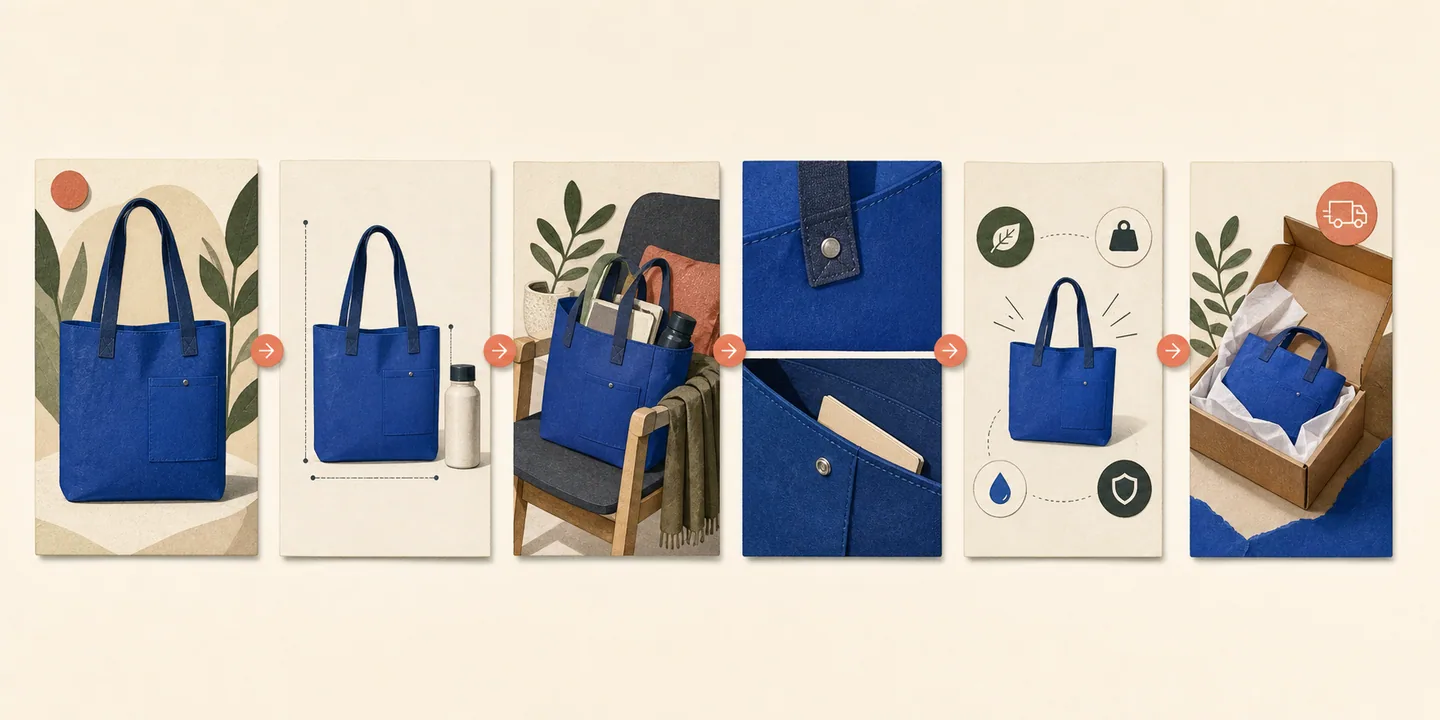
Your images do more than show your product. They signal quality, create desire, and answer unspoken questions. The order matters because shoppers scroll fast—you need to front-load your most compelling visuals.
The Proven Carousel Order:
| Position | Image Type | Purpose |
|---|---|---|
| 1. Hero Shot | Clean product on white/neutral background | Immediate clarity—what is this? |
| 2. Lifestyle | Product in use, real context | Create desire—imagine using this |
| 3. Size Reference | Product next to common object | Remove uncertainty—how big is this? |
| 4. Detail/Features | Close-up of key features | Answer questions—what makes this special? |
| 5. Ingredients/Specs | Label, materials, technical details | Build trust—for shoppers who need details |
| 6. UGC/Results | Customer photo, before/after, review screenshot | Social proof—others love this |
| 7. Packaging | Box, unboxing, what’s included | Set expectations—what will I receive? |
| 8. Brand/Trust | Certification badges, guarantees, company info | Final reassurance—this is legit |
TikTok’s technical requirements:
- Minimum 600×600 pixels (aim for 1000×1000 or higher)
- Square format (1:1) performs best
- Maximum 9 images per listing
- First image: No text, graphics, or watermarks
- All images: Clear, well-lit, accurate representation
Good vs. Bad Carousel Examples:
Bad (Common Mistakes):
- Image 1: Blurry product photo with text overlay
- Image 2: Same angle, slightly different lighting
- Image 3: Stock photo that doesn’t match actual product
- Image 4: Low-resolution screenshot from supplier
- Image 5: Random lifestyle photo with no product visible
Good (Optimized Sequence):
- Image 1: Clean white background, product front view, professional lighting
- Image 2: Product in use—model wearing/applying/using in real setting
- Image 3: Product next to phone or hand for scale reference
- Image 4: Close-up of texture, material, or key feature
- Image 5: Ingredient list or spec sheet clearly visible
- Image 6: Customer-submitted photo showing results
- Image 7: Product in packaging with accessories included
The faster path to the right imagery: Test different image sequencing—lifestyle-first versus product-first—against synthetic shoppers. Kettio shows you which visual approach creates stronger purchase intent for your specific product category. Some audiences want to see the product clearly first; others respond better to aspiration-driven lifestyle shots.
Video Listing Best Practices
TikTok allows one video per product listing (maximum 5MB). Used correctly, this video can be your highest-converting asset. Used poorly, it’s wasted space.
When to use video vs. static images:
| Use Video | Stick to Images |
|---|---|
| Product has motion/functionality (gadgets, tools, appliances) | Simple products with clear function (basic apparel, accessories) |
| Results are visual and transformative (skincare, fitness, cleaning) | Products where visuals don’t add information |
| Demonstration adds value (assembly, usage, styling) | Low-margin products where video production isn’t ROI-positive |
| Your target audience is video-first (Gen Z, TikTok natives) | Limited resources—better to have great images than mediocre video |
Video best practices:
Optimal length: 15–30 seconds
- Long enough to demonstrate value
- Short enough to maintain attention
- TikTok’s sweet spot for product content
Thumbnail selection:
- Choose a frame that shows the product clearly
- Avoid motion-blurred frames
- Consider adding a text overlay in the video itself (not on the thumbnail)
- Test multiple thumbnail options if possible
Content structure:
- 0–3 seconds: Hook—show the product or result immediately
- 3–15 seconds: Demonstration—product in action, transformation happening
- 15–25 seconds: Proof—results, features, social validation
- 25–30 seconds: CTA—clear next step, urgency if applicable
What to avoid:
- Slow intros with logos or branding
- Music that drowns out any voiceover
- Vertical video with black bars (use full 9:16)
- Overly polished, commercial-style production (feels like an ad)
- Long videos that lose attention before the CTA
There’s a shortcut most sellers miss: Instead of guessing which video approach will resonate, test your video concept against synthetic shoppers before you invest in full production. Upload your storyboard or rough cut to Kettio and get feedback on hook strength, clarity, and purchase intent. Refine based on feedback, then produce the final version.
A/B Testing Methodology for Listings
Optimization without testing is just guessing. A systematic A/B testing approach lets you validate changes before rolling them out fully—and compound small wins into significant conversion gains.
The Test-Iterate-Scale Framework:
flowchart TD
    A["Identify Low-Performing Element"] --> B["Form Hypothesis"]
    B --> C["Create Variation"]
    C --> D["Run Test (Min 2 Weeks)"]
    D --> E{"Statistical Significance?"}
    E -->|Yes| F{"Winner Clear?"}
    E -->|No| G["Extend Test Duration"]
    G --> D
    F -->|Yes| H["Implement Winner"]
    F -->|No| I["Iterate & Retest"]
    H --> J["Scale to Full Traffic"]
    I --> B
    J --> K["Identify Next Element"]
    K --> A

    style A fill:#e1f5ff,color:#333,stroke:#e1f5ff
    style H fill:#d4edda,color:#333,stroke:#d4edda
    style J fill:#d4edda,color:#333,stroke:#d4edda
What to test (in order of impact):
| Priority | Element | Expected Impact | Test Complexity |
|---|---|---|---|
| 1 | Main product image | High | Low |
| 2 | Price presentation | High | Low |
| 3 | Title keywords/benefits | Medium-High | Medium |
| 4 | Video vs. static hero | Medium-High | High |
| 5 | Description hook | Medium | Medium |
| 6 | Image carousel order | Medium | Low |
| 7 | Urgency/scarcity messaging | Medium | Low |
| 8 | Shipping/returns framing | Low-Medium | Low |
Minimum traffic thresholds:
| Test Type | Min Visitors/Variant | Min Duration | Notes |
|---|---|---|---|
| High-impact changes (images, pricing) | 1,000+ | 1 week | Faster results with bigger changes |
| Medium-impact changes (titles, descriptions) | 5,000+ | 2 weeks | Standard test duration |
| Low-impact changes (minor copy tweaks) | 10,000+ | 2–4 weeks | Requires more data for significance |
Testing rules:
- Test one variable at a time. Changing your image AND title together makes it impossible to know which drove the result.
- Run for full weeks. Ending a test on Wednesday skews results if your traffic patterns differ weekday vs. weekend.
- Don’t stop early. Even if one variant pulls ahead dramatically in the first few days, let the test run its course. Early winners often regress.
- Document everything. Hypothesis, test dates, traffic split, results, learnings. This compounds into institutional knowledge.
- Iterate on inconclusive results. “No significant difference” is still a learning—it means that variable matters less than you thought.
The faster way through this: Running live A/B tests on TikTok Shop takes weeks and burns budget on underperforming variants. In Kettio, you can test listing variations synthetically—all in one session. Upload your title options, image sequences, or description drafts, define your target demographic, and get scores plus written feedback from 1,000 AI consumers who think like your buyers. Learn more about how synthetic audience panels work and why they predict real performance. The test-iterate-scale loop becomes something you can run through in an afternoon instead of over weeks of expensive trial and error.
The Bottom Line
TikTok Shop listing optimization isn’t about following a checklist—it’s about understanding the system and working within it. The algorithm rewards listings that:
- Use clear, keyword-rich titles that match search intent
- Provide detailed, benefit-driven descriptions that convert interest into action
- Display high-quality images in an order that builds desire and removes uncertainty
- Include video when it adds demonstrable value
- Continuously test and iterate based on data
The sellers dominating TikTok Shop aren’t lucky. They’re systematic. They treat listing optimization as a skill to be developed, tested, and refined.
Your competitors are guessing. You now have a playbook.
🏪 Connect Your TikTok Shop
Kettio’s TikTok Shop tool audits your listings, scores your images and descriptions, and tells you exactly what to fix—powered by synthetic shoppers who think like your buyers.
Stop guessing which listing variation will convert. Test your titles, images, and descriptions against synthetic shoppers who think like your buyers—before your next dollar goes to waste.
Frequently asked questions
What is the optimal title length for TikTok Shop product listings?
TikTok truncates titles around 80 characters in search and browse views. Aim for 40–80 characters total, front-load the primary keyword, and follow the formula: [Primary Keyword] + [Benefit] + [Differentiator] + [Size/Variant].
How many images should a TikTok Shop product listing have?
Use 6–9 images per listing. Image 1 must be a clean white-background hero (algorithm signal). Images 2–5 should show lifestyle context, scale references, and benefit close-ups. Images 6–9 are for size charts, ingredient lists, and trust signals.
Does TikTok Shop reward keyword stuffing in product titles?
No. TikTok Shop's ranking is hybrid — content signals (title, description, images) determine initial visibility, but engagement signals (CTR, watch time, add-to-cart rate, conversion rate) determine whether a listing rises or sinks. Keyword-stuffed titles that hurt CTR get deprioritized within hours.
How long does it take for TikTok Shop listing optimizations to show results?
Algorithm re-evaluation typically takes 48–72 hours after a listing edit. CTR signals are the fastest input; conversion-rate signals take longer to accumulate. Avoid making more than one change at a time so you can attribute the lift correctly.
Can I A/B test TikTok Shop listings before publishing?
Yes — use a synthetic audience platform like Kettio to score title/image variants against simulated TikTok shoppers before going live. This avoids the algorithm penalty of editing live listings and lets you arrive at a winning combination without burning real impressions.
Try it on your ads
Compare your own ads, free.
Upload two static ads, choose your buyer, and get a quick prediction with clear next steps. No signup or credit card.
Find my winning ad →